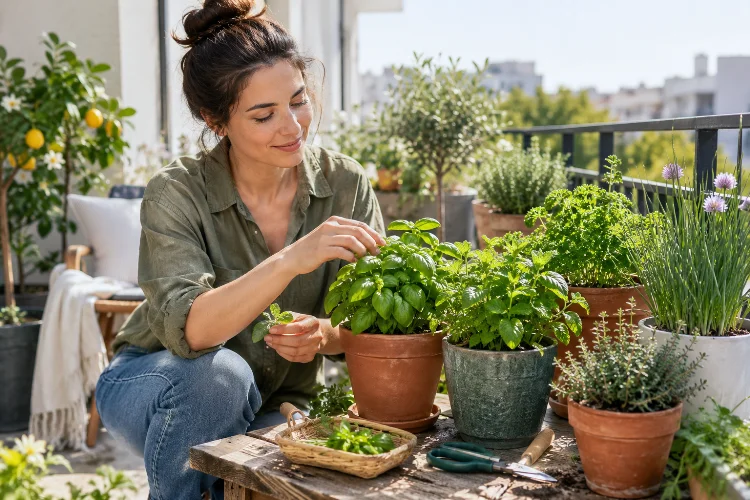
Starting a herb garden sounds simple until you walk into a garden center and discover dozens of plants that all seem to need different amounts of sunlight, water, space, and attention.
For a beginner, the goal does not need to be creating an impressive botanical collection.
A much better starting point is building a small garden where you can actually observe plants growing, make a few mistakes, harvest something useful, and gradually understand how herbs respond to their environment.
That is what makes beginner-friendly herbs for a practical home learning garden so valuable.
Plants such as basil, mint, parsley, chives, thyme, and rosemary can introduce basic concepts like germination, pruning, soil drainage, plant life cycles, aroma, harvesting, and propagation.
You also do not need a large backyard. A balcony, patio, windowsill, or collection of containers can become a miniature learning garden.
The key is starting small and choosing herbs that teach you something while still being manageable.
Why Start With a Small Home Herb Garden?
A learning garden works best when you can regularly observe it.
When you grow only a few herbs, it becomes easier to notice how quickly soil dries, where sunlight falls during the day, how new leaves develop, and what happens after a plant is harvested.
Penn State Extension recommends that beginning gardeners start with a small herb garden while they become familiar with the culture and care of different plants. Herbs also vary in their life cycles: some are annuals, others biennials, and others perennials.
That variation makes a small herb collection surprisingly educational.
Instead of simply reading that plants have different growth patterns, you can observe those differences yourself. Your garden becomes a living classroom where the lesson changes every week.
Basil: A Great Herb for Learning Fast Growth
Basil (Ocimum basilicum) is one of the easiest places to begin.
It grows relatively quickly under warm, bright conditions, and its leaves can be harvested repeatedly.
University of Minnesota Extension describes sweet basil as one of the easiest and most popular culinary herbs to grow and recommends a sunny location with well-drained soil.
Basil is particularly useful for learning about pruning.
If you regularly pinch or harvest growing tips, you can watch the plant produce new branches. Ignore it for long enough and you may eventually see flowers developing instead.
That makes basil a simple demonstration of how gardening decisions influence plant shape and growth.
Because basil is generally grown as an annual, it also introduces beginners to the idea of a complete seasonal plant cycle. From seed or young transplant to mature plant, flowering, and seed production, there is plenty to observe.
For a begining gardener, that fast feedback can make the experience much more rewarding.
Mint: Perfect for Learning About Vigorous Growth
Mint is famously enthusiastic.
Give it suitable conditions and it may spread far beyond the area where you originally planted it.
University of Minnesota Extension notes that hardy perennial mints can spread aggressively, while Clemson Extension recommends planting spreading mints in containers or planters to keep them under control.
That characteristic actually makes mint an excellent learning plant.
It demonstrates why gardeners need to think about mature plant size, underground growth, competition, and boundaries. A small mint plant may look harmless when purchased, but watching it expand teaches a lesson that is difficult to understand from a textbook alone.
For a home learning garden, placing mint in its own pot is usually the simplest approach.
You can also experiment with taking stem cuttings and observing root development. Just keep different mint varieties labelled seperately if you are comparing them.
Chives: An Easy Herb for Repeated Harvesting
Chives are another beginner-friendly choice, particularly if you want a plant that can be harvested again and again.
Penn State lists chives among perennial herbs, meaning established plants can continue growing for more than one season under suitable conditions.
Their narrow leaves also make growth easy to observe.
Trim some leaves and you can monitor how the plant replaces them. Leave another section uncut and compare the difference over time.
This turns harvesting into a small experiment rather than simply a kitchen activity.
Chives can also introduce learners to plant division. Mature perennial clumps may eventually be separated into smaller sections, giving you a practical demonstration of vegetative propagation.
It is a useful reminder that seeds are not the only way plants reproduce or expand in a garden.
Parsley: Useful for Understanding Plant Life Cycles
Parsley can teach a slightly different lesson.
Unlike basil, which is commonly treated as an annual, parsley is botanically a biennial. Penn State Extension identifies parsley as one of the herbs that normally live for two growing seasons, with flowering occurring during the second season.
That makes parsley interesting for learners who want to understand plant development over a longer period.
During its leafy stage, you can observe new growth and practice careful harvesting. If conditions allow the plant to continue its natural cycle, you may later observe changes associated with flowering and seed production.
Parsley also belongs to a different plant family from basil and mint. Growing them together gives beginners an easy opportunity to compare leaf shapes, growth habits, aromas, and moisture preferences.
A learning garden becomes much more interesting when the plants do not all behave the same way.
Thyme: A Lesson in Drainage and Restraint
Beginners often assume that caring for a plant means giving it more water.
Thyme can help break that habit.
Many culinary herbs, especially those associated with Mediterranean growing conditions, perform well in well-drained soil and do not appreciate constantly wet roots.
University of Minnesota Extension advises avoiding soggy conditions when growing herbs because persistent moisture can contribute to root problems.
Growing thyme therefore teaches an important skill: observing before watering.
Instead of following a rigid schedule, check the soil. Notice whether the container remains wet, dries rapidly, or behaves differently during hot and cloudy weather.
This teaches beginners that good plant maintenence is partly about responding to conditions rather than automatically doing the same thing every day.
Thyme’s compact growth also makes it convenient for small containers and mixed herb gardens.
Rosemary: Learn How Different Herbs Need Different Conditions
Rosemary is useful because it shows that not every herb behaves like basil or parsley.
It generally appreciates strong light and good drainage. Penn State’s indoor herb guidance lists rosemary among herbs that perform best with direct sunlight, while Illinois Extension also includes it among herbs commonly grown indoors when adequate light is available.
Rosemary grows more slowly than fast-growing basil, so it encourages patience.
Its woody stems also provide a useful contrast with softer herbs. You can compare texture, growth rate, fragrance, leaf structure, and water requirements within the same small garden.
Climate matters, however. Rosemary may behave as a long-lived perennial in warm environments but needs greater protection in colder regions.
That difference itself is a useful gardening lesson: plant care is always influenced by the local enviroment.
Oregano: An Easy Introduction to Perennial Herbs
Oregano is another practical choice for learners who want a relatively manageable perennial herb.
It belongs to the mint family, along with basil, rosemary, thyme, sage, and mint. University of Minnesota Extension notes that members of this family are commonly grown for their aromatic leaves.
Oregano is useful for observing how harvesting influences bushiness and how aromatic compounds become noticeable when leaves are rubbed or crushed.
It can also help beginners compare fresh and dried herbs.
Instead of seeing harvesting as the end of the growing process, you begin thinking about timing, preservation, storage, and how plants can be used after leaving the garden.
These connections make the garden more than a collection of pots. It becomes a practical introduction to plant biology and food production.
Set Up the Garden for Learning, Not Perfection
You do not need expensive equipment to create an effective home learning garden.
Start with several containers that have drainage holes, suitable potting media, access to good light, and plants you genuinely want to observe or use.
Penn State recommends considering how you plan to use herbs before choosing what to grow, while USDA gardening guidance emphasizes the importance of healthy, well-draining soil.
Keep a simple garden journal.
Record planting dates, sunlight, watering, new leaves, flowering, pest problems, and harvests. Taking a photo once a week can make changes much easier to notice.
You could even run tiny experiments. Place similar basil plants in slightly different light conditions, compare mint grown in two container sizes, or track how frequently thyme needs watering compared with parsley.
Do not worry when something fails.
A struggling plant can teach you just as much as a thriving one if you try to understand what happened.
Remember That Growing Herbs Is Different From Using Them Medicinally
A home herb garden is an excellent place to learn plant identification, growth, propagation, harvesting, and culinary uses.
It should not automatically be treated as a home pharmacy.
Some plants described as herbs may cause unwanted effects, interact with medicines, or be inappropriate for certain people when consumed in concentrated or medicinal preparations. Growing a plant successfully does not mean every preparation made from it is automatically safe.
For a beginner learning garden, familiar culinary herbs are often the simplest starting point.
Correctly identify every plant, know which part is commonly used, and avoid consuming plants treated with products not intended for edible crops.
That keeps the focus where it belongs: learning about plants carefully and responsibly.
Choosing beginner-friendly herbs for a practical home learning garden can turn a few simple pots into an ongoing introduction to horticulture.
Basil teaches fast growth and pruning, mint demonstrates spreading habits, chives show repeated harvest and division, parsley illustrates life cycles, while thyme, rosemary, and oregano reveal how different herbs respond to light, water, and soil conditions.
The best learning garden does not need dozens of species. Five or six well-observed plants can teach far more than a crowded collection you barely have time to maintain.
Start with a few herbs that suit your available space and climate, label them clearly, keep simple notes, and observe what changes each week. Your first goal is not perfection. It is becoming a more curious and attentive plant learner.