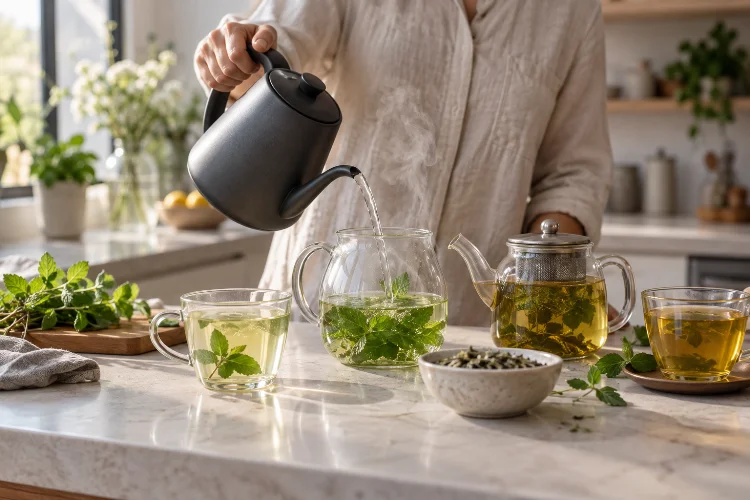
Making an herbal infusion seems almost impossible to get wrong. Put some leaves in a cup, add hot water, wait a few minutes, and drink. Simple, right?
Mostly – but water temperature can change the result more than many beginners realize.
The heat of the water influences how quickly different substances move from plant material into the liquid. It can affect color, aroma, bitterness, flavor intensity, and the amount of certain water-soluble plant compounds that end up in your cup.
Researchers studying both traditional tea and herbal infusions have found that changing temperature and steeping time can measurably change their chemical and sensory profiles.
Understanding why water temperature matters when making herbal infusions does not mean you need laboratory equipment in your kitchen.
Instead, it helps you understand why boiling water works well for some preparations while slightly cooler water may create a more pleasant result for others.
The real lesson is simple: hotter is not always automatically better.
Water Temperature Controls the Extraction Process
An herbal infusion is essentially a simple extraction.
When leaves, flowers, or other plant materials contact water, some of their soluble compounds move into the liquid. Heat generally speeds up this process because molecules move more rapidly at higher temperatures.
The NIH Office of Dietary Supplements describes herbal teas and infusions as preparations made by adding boiling water to fresh or dried botanicals and allowing them to steep. Tougher plant materials may require a decoction, which involves boiling and simmering them for longer.
Temperature matters because different plant compounds do not behave identically.
Some dissolve readily in moderately hot water, while others are extracted more efficiently at higher temperatures. Research on several teas has found that raising brewing temperature can increase the extraction of polyphenols and other compounds.
That does not mean every herb should automatically be brewed at 100°C.
It simply means temperature is one of the main variables controlling what ends up in the final infusion.
Hotter Water Often Extracts More Plant Compounds
One reason people use hot rather than cold water is efficiency.
In a study examining seven popular teas between 25°C and 100°C, extraction of several antioxidant compounds generally increased as water temperature rose, with the highest overall extraction occurring at 100°C under the study conditions.
Herbal plants can show similar patterns.
Research on lemon balm compared infusions prepared using 100°C water for five minutes with room-temperature water for two hours. The hot preparations contained higher levels of several measured phenolic compounds and greater antioxidant capacity.
A 2026 study of olive leaf infusions also found that preparations made at 90°C generally extracted more total phenolics than those prepared at 70°C, although individual compounds responded differently.
This last point is important.
Plant chemistry is complicated. A temperature that increases the extraction of one compound may have little effect – or a different effect – on another.
So “hotter extracts more” can be a useful general principle, but it is not a universal recipe.
Temperature Also Changes Flavor and Bitterness
Extraction is not only about potentially beneficial compounds. It also affects taste.
Hotter water can pull more flavor-producing substances from plant material. Depending on the herb, that may create a stronger and more satisfying infusion – or one that becomes excessively bitter or astringent.
Tea research provides a clear example.
A study examining Longjing tea found that lower brewing temperatures of around 70–80°C reduced bitterness and astringency, while higher temperatures increased the extraction of compounds associated with those sensations.
Herbal leaves contain different chemical profiles from Camellia sinensis tea, so those exact temperatures should not simply be copied to every herb.
The broader principle still applies: changing brewing temperature changes what you taste.
If an infusion repeatedly tastes unpleasantly harsh, temperature is one variable worth testing alongside herb quantity and steeping time.
Instead of immediately adding less herb, try slightly cooler water and compare the result.
Delicate Aromas Can Respond Differently to Heat
Have you ever crushed fresh mint, lemon balm, or another aromatic herb and noticed how quickly its scent fills the air?
Many herbs contain volatile compounds responsible for their characteristic aromas. “Volatile” means these compounds can readily enter the air, which is why you can smell them so easily.
Very hot water helps release aromatic substances, but prolonged heating can also change the aromatic profile. Recent research on mallow herbal tea compared short hot brewing, extended hot brewing, and cold infusion.
The researchers found distinct volatile profiles under each method, with short hot brewing producing particularly favorable aroma scores while extended hot brewing altered several compounds.
For the home learner, there is a practical takeaway.
Do not assume that keeping an infusion extremely hot for much longer will continuously improve it.
Covering a cup while aromatic leaves steep may also help retain warmth and some of the aroma that would otherwise escape with steam.
This is one reason herbal preparation is partly about balance rather than maximum extraction.
Water Temperature and Steeping Time Work Together
Temperature should never be considered separately from time.
Cooler water generally extracts compounds more slowly, while hotter water usually works faster. That means a low-temperature infusion may need substantially more time to reach a comparable strength.
For example, researchers studying low-temperature green tea found that prolonged cold extraction could still produce substantial amounts of certain compounds, even though the extraction pattern was different from conventional hot brewing.
Think of temperature and time as two connected controls.
If you dramatically reduce one, you may need to increase the other.
This explains why cold infusions are often allowed to steep for hours rather than minutes.
It also explains why leaving delicate leaves in near-boiling water for an extremely long period may produce a much stronger – and sometimes less pleasant – drink than expected.
A useful learning exercise is to prepare the same herb at two temperatures while keeping the amount of plant material and steeping time identical.
You may notice differences in color, scent, bitterness, and overall strenght almost immediately.
Different Herbs Do Not Need Exactly the Same Temperature
There is no single perfect brewing temperature for every herbal infusion.
Plants differ in leaf structure, moisture content, particle size, chemical composition, and traditional preparation methods. Fresh leaves can also behave differently from dried material.
Research consistently shows that brewing conditions interact with the physical characteristics of plant material. Particle size, for example, can influence extraction because finely broken material exposes more surface area to water.
This means a powdered herb may release compounds much faster than intact leaves.
For familiar culinary leaves such as mint or lemon balm, hot water and relatively short steeping are common starting methods. But a specific herbal reference may recommend different conditions for another plant.
Beginners should therefore avoid treating a temperature chart as an absolute rule.
A better habit is to check preparation guidance for the specific species and plant part being used.
That is particulary important when moving beyond ordinary culinary herbs.
Infusions and Decoctions Should Not Be Confused
Temperature becomes even more important when you start working with different plant parts.
Leaves and flowers are commonly prepared by infusion because their tissues are relatively soft. Roots, bark, hard berries, and similar materials may sometimes require more aggressive extraction.
That method is called a decoction.
According to the NIH Office of Dietary Supplements, decoctions may involve bringing plant material to a boil and then simmering it for several minutes, which can produce a more concentrated preparation.
So pouring hot water over peppermint leaves and simmering tough bark for twenty minutes are not simply two versions of the same process.
They are different preparation methods.
Knowing the difference helps prevent one of the most common beginner mistakes: assuming that every part of every plant should be prepared like tea leaves.
Boiling Water Is Not Always the Same Temperature Everywhere
There is another interesting detail that often gets overlooked.
Water normally boils around 100°C at sea level, but the boiling point decreases as altitude increases because atmospheric pressure becomes lower.
That means “use boiling water” does not produce precisely the same brewing temperature everywhere.
For casual home infusions, this difference usually does not require complicated calculations. But it illustrates why preparation instructions should be understood as practical guidance rather than laboratory-perfect numbers.
Water also starts cooling immediately after leaving the kettle.
A cup, teapot, room temperature, amount of water, and whether the vessel is covered can all influence how quickly that happens.
In real kitchens, herbal brewing temperature is therefore rarely perfectly constant.
That is perfectly fine.
Consistency matters more than obsesive precision when you are simply learning how an herb behaves.
Do Not Confuse Stronger Extraction With Greater Health Benefits
A darker or stronger-tasting infusion may contain more extracted plant material, but that does not automatically make it healthier.
Laboratory measurements such as total phenolic content or antioxidant activity can help researchers understand the chemistry of an infusion. They do not automatically prove that drinking a more concentrated preparation produces better health outcomes in people.
This distinction matters especially with herbs marketed for medicinal purposes.
NCCIH emphasizes that products described as natural are not automatically safe and that herbs can cause side effects or interact with medications.
Increasing temperature, steeping time, and plant quantity simply to produce the strongest possible drink is therefore not a sensible goal.
For everyday learning, focus on correct plant identification, appropriate preparation guidance, reasonable quantities, and enjoyable sensory qualities.
Herbal brewing should be informed, not competitive.
A Simple Way to Experiment With Temperature
You can explore temperature effects without sophisticated equipment.
Choose a familiar culinary herb that you already know is suitable for infusion. Prepare equal amounts in two identical cups.
Use hotter water for one cup and slightly cooler water for the other. Keep the herb quantity, water volume, and steeping time identical.
Then compare them.
Look at the color. Smell both cups. Notice whether one tastes stronger, brighter, more bitter, smoother, or more aromatic.
Write down your observations.
Next time, change only the steeping duration.
This basic experiment teaches an important scientific habit: change one variable at a time.
You will quickly discover that making an infusion is not simply about mixing leaves and water. It is a small extraction process influenced by several interacting factors.
Understanding why water temperature matters when making herbal infusions helps explain why the same plant can produce surprisingly different drinks.
Hotter water generally speeds extraction and may release more plant compounds, but it can also influence bitterness, aroma, and overall sensory quality.
Temperature also works together with steeping time, plant part, particle size, and the amount of herbal material used. There is no universal temperature that is ideal for every herb.
Start with reliable preparation guidance for the specific plant you are using, then experiment carefully with familiar culinary herbs.
Compare temperatures, keep simple notes, and pay attention to aroma and flavor rather than chasing the strongest possible extraction. A little observation can turn an ordinary cup of herbal tea into a practical lesson in plant chemistry.