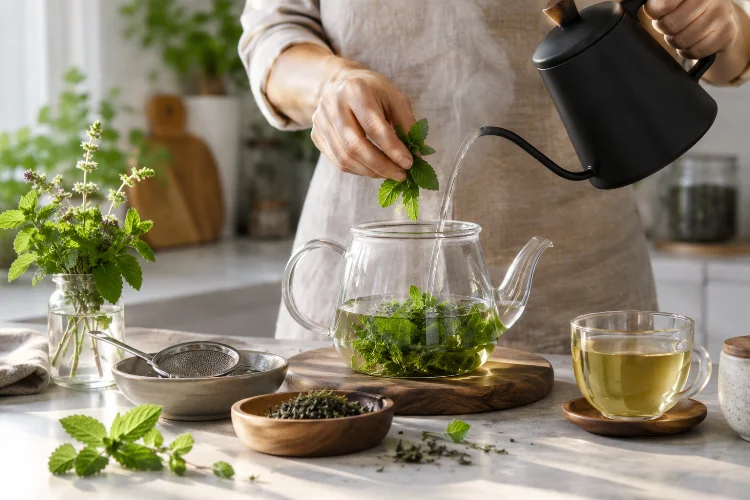
Making a herbal leaf infusion is one of the simplest ways to explore herbs at home.
You place plant material in hot water, wait while some of its water-soluble compounds move into the liquid, strain it, and you have a fragrant drink that can also become a practical lesson in plant preparation.
Simple does not mean careless, though.
The plant needs to be correctly identified, the leaves should be suitable for consumption, your equipment should be clean, and the amount and steeping time should make sense for the specific herb.
A handful of unknown garden leaves should never become an experimental tea simply because they smell pleasant.
Learning the simple steps for preparing a basic herbal leaf infusion is therefore about more than boiling water. It introduces useful concepts such as plant identification, fresh versus dried material, extraction, steeping time, food hygiene, and herbal safety.
Once you understand the basic method, you can explore familiar culinary herbs more confidently while learning why different plants may require different preparation approaches.
1. Understand What a Herbal Leaf Infusion Actually Is
An herbal infusion is a water-based preparation made by steeping plant material in hot water.
The NIH Office of Dietary Supplements describes teas and infusions as preparations in which boiling water is added to fresh or dried botanicals and the material is allowed to steep.
It distinguishes this approach from a decoction, where tougher materials such as some roots, bark, or berries are boiled and simmered for longer.
That difference matters.
Soft plant parts such as leaves and flowers often release their flavors and water-soluble compounds without prolonged boiling. Tougher roots and bark may need more intensive extraction.
For a beginner, think of infusion as the gentler method.
Peppermint leaves, basil leaves, lemon verbena, sage, and thyme are examples of leaves that may be prepared as infusions when they are correctly identified and known to be appropriate for culinary use.
2. Start With a Familiar and Correctly Identified Herb
The most important ingredient is not the water. It is knowing exactly what plant you are using.
Common names can sometimes cause confusion because similar names may be used for different species. If you are growing herbs yourself, keep plant labels and learn the botanical name whenever possible.
For beginners, familiar culinary herbs are generally easier learning materials than unusual wild plants.
Mint provides a simple example. A University of Illinois Extension tea-garden guide suggests about 1 teaspoon of dried mint leaves or 3 teaspoons of crushed fresh leaves for one cup of water, with the infusion steeped according to taste.
The same guide shows that other herbs use different quantities and steeping times, which is an important reminder that there is no universal recipe for every plant.
Avoid harvesting unidentified plants from roadsides, public parks, or unfamiliar gardens.
Correct identification should always come before experimentation.
3. Prepare Fresh or Dried Leaves Properly
Both fresh and dried leaves can be used for many culinary infusions, but they behave differently.
Fresh leaves contain a large amount of water, so recipes commonly use a larger volume of fresh material than dried material. Drying concentrates the plant material, which is why replacing fresh herbs with the same volume of dried leaves can produce a much stronger result.
If you are using fresh garden herbs, inspect them carefully.
Remove leaves that are rotten, badly damaged, moldy, or contaminated. The FDA recommends washing fresh produce thoroughly under running water before preparation and specifically advises against using soap or detergent on produce.
Wash your hands and use clean cups, strainers, spoons, and preparation surfaces as well.
This part of the process may feel less exciting than brewing the herbs, but good hygiene is part of good herbal preperation.
4. Measure the Herb Instead of Guessing
It is tempting to grab a large handful of leaves and assume that more plant material will create a “better” infusion.
That is not necessarily true.
Different herbs vary greatly in flavor strength and chemical composition. Rosemary, for example, can produce a strong-tasting infusion with considerably less material than some milder leaves.
The University of Illinois Extension guide recommends different amounts for mint, rosemary, basil, lemon verbena, sage, and thyme rather than applying one measurement to everything.
When learning a new herb, follow a reputable recipe or monograph for that specific plant.
Keep simple notes about how much fresh or dried material you used, how much water you added, and how long you steeped it. This turns tea making into a small learning experiement.
If the flavor is too weak, you can adjust the next batch gradually instead of immediately doubling or tripling the herb.
5. Heat the Water and Pour It Over the Leaves
For a basic culinary leaf infusion, heat clean drinking water and pour it over the prepared leaves in a heat-resistant cup, mug, or teapot.
NIH’s botanical guidance describes tea and infusion preparation as adding boiling water to botanical material and allowing it to steep.
If the safety of your drinking water is uncertain, deal with that problem first. The CDC states that boiling is an effective method for killing disease-causing germs in water, although boiling cannot remove harmful chemicals or radioactive contamination.
After adding the hot water, covering the cup or pot can help retain heat and aromatic vapors.
You do not need complicated equipment. A cup with a small plate placed over the top can work perfectly well.
The goal is simply to keep the leaves in contact with hot water long enough for extraction to occur.
6. Give the Leaves Enough Time to Steep
Steeping time influences flavor, aroma, strength, and bitterness.
Five minutes is a useful reference point for several common tea-garden herbs, but individual plants vary considerably.
The University of Illinois Extension guide, for example, lists around 10 minutes for thyme and sage and a longer steep for lemon verbena, while mint can be adjusted according to taste.
This is why herbal learning should not rely on one rigid timer.
Start with the recommendation for the herb you are using. Then observe how the aroma, color, and flavor change.
Longer is not automatically better.
Some leaves become unpleasantly bitter or overpowering when left in hot water for too long. Increasing steeping time can also change what is extracted into the water.
When testing variations, change one thing at a time. If you increase both the amount of herb and the steeping time simultaneously, you will not know which change caused the difference.
7. Strain, Taste, and Record What You Notice
Once the infusion has steeped, remove the leaves with a clean strainer.
Allow the drink to cool enough to consume safely before tasting it.
Pay attention to more than whether you “like” it. Notice the aroma, color, bitterness, sweetness, cooling sensation, or other characteristics.
This is where a simple infusion becomes an educational exercise.
You might compare fresh and dried mint prepared seperately, for example. Or make two small cups using equal amounts of the same herb but different steeping times.
Keep short notes.
Over several sessions, you will begin seeing patterns in how plant material, water volume, temperature, and time influence the final drink.
Avoid assuming that a stronger taste means greater health benefits. Flavor intensity and clinical effectiveness are completely different questions.
8. Treat Herbal Safety as Part of the Recipe
A plant being natural does not automatically make every amount or preparation safe.
NCCIH emphasizes that natural products can cause side effects and that some herbs have important safety concerns. Herbal products can also interact with prescription and over-the-counter medicines.
This becomes especially important when people move beyond ordinary culinary use and begin drinking concentrated preparations regularly.
MedlinePlus recommends discussing herbal remedies with a healthcare professional when medicines are being taken and advises additional caution during pregnancy, breastfeeding, before surgery, and in other situations where risks may be higher.
Do not use an infusion as a substitute for necessary medical treatment simply because an online source describes a plant as medicinal.
Also avoid assuming that instructions for one species apply to another plant with a similar name.
Good herbal practice combines curiosity with caution.
9. Make Only What You Plan to Use
For beginners, making a single cup or small pot is usually easier than preparing a large batch.
Small batches let you adjust the amount and steeping time without wasting plant material. They also reduce the need to store prepared infusions for long periods.
Fresh herbs themselves should also be handled like other perishable produce. FDA guidance recommends keeping perishable fresh herbs refrigerated at 40°F (about 4°C) or below.
If you prepare more infusion than you intend to drink immediately, avoid leaving it sitting at room temperature for extended periods. Use clean containers and refridgerate leftovers promptly when appropriate.
For learning purposes, however, fresh single-cup batches are usually the simplest option.
You can prepare another cup whenever you want to compare a different herb, quantity, or steeping time.
Learning the simple steps for preparing a basic herbal leaf infusion gives beginners an easy way to connect plant knowledge with hands-on practice.
The basic process is straightforward: identify an appropriate herb, prepare clean leaves and equipment, measure the plant material, add hot water, allow enough steeping time, strain, and observe the result.
The most important lesson is that every herb deserves to be considered individually. Amounts, preparation times, flavors, and safety considerations can differ from one species to another.
Start with a familiar culinary leaf such as mint and follow a reliable preparation guide. Record what you use and what you notice. As your knowledge grows, you can compare other herbs while keeping identification, hygiene, evidence, and safety at the center of your learning.