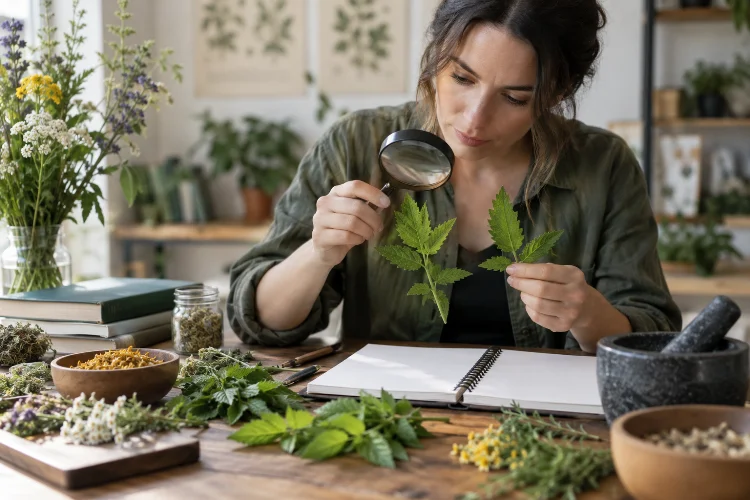
Plants have been used for food, wellness, and traditional healing for thousands of years.
Today, interest in herbal teas, botanical supplements, medicinal plants, and natural wellness continues to grow, especially as people look for practical ways to understand what comes from the natural world.
But learning about herbs involves more than memorizing which plant is traditionally used for which purpose. Two plants can look surprisingly similar while having very different effects.
The same herb may also behave differently depending on the plant part, preparation method, concentration, or medications a person is already taking.
That is why herbal education supports safer plant-based learning. Good education teaches curiosity alongside caution.
Instead of presenting herbs as automatically beneficial because they are natural, it helps learners understand identification, traditional use, scientific evidence, preparation, dosage concepts, interactions, and responsible decision-making.
The result is not simply more knowledge about plants. It is better herbal literacy.
What Does Herbal Education Actually Teach?
Herbal education is the structured study of plants used in traditional, culinary, wellness, or medicinal contexts.
Depending on the course, learners might explore botany, plant chemistry, traditional knowledge, preparation methods, safety, research, sustainability, and basic human physiology.
One of the first lessons is usually that an herb is more complex than its common name. Botanical identification matters because several plants may share similar common names.
The NIH Office of Dietary Supplements explains that botanicals are identified using scientific names consisting of a genus and species. Learning these names can reduce confusion and improve identifcation when comparing books, research papers, products, and plant specimens.
Herbal education therefore encourages learners to ask better questions. What species is this? Which part of the plant is being discussed? How was it prepared? What evidence supports the claim?
Those questions are fundamental to safer plant-based learning.
Understanding That Natural Does Not Automatically Mean Safe
One of the most important ideas in herbal education is surprisingly simple: natural does not mean harmless.
Plants contain biologically active compounds. That is one reason humans have been interested in them for medicine, food, flavor, and other purposes for centuries. But biological activity can also create side effects, toxicity, allergies, and interactions.
NCCIH specifically warns that products described as natural are not automatically safer or better. Some botanicals can cause serious adverse effects, and evidence supporting their effectiveness varies considerably between products and conditions.
Consider kava, for example. It has traditionally been used in several contexts, yet safety concerns have been raised about possible liver injury. St. John’s wort provides another useful example because it can interact with numerous medicines.
Good education replaces the assumption that “plant equals safe” with a more useful idea: every plant should be evaluated individually.
Correct Plant Identification Reduces Avoidable Mistakes
Imagine learning that a particular leaf has a traditional use and then collecting a similar-looking species in the wild. Without botanical knowledge, a simple identification error could become a serious problem.
That is why plant identification is an essential foundation of herbal learning.
Students may learn to examine leaves, flowers, stems, roots, fruits, growing environments, and botanical characteristics. Scientific naming adds another layer of precision because common names vary between regions and languages.
Context also matters. Fresh ginger from a grocery store, dried ginger powder, concentrated extracts, teas, and capsules may all come from the same plant, but they are not automatically equivalent preparations.
A well-designed herbal course teaches learners to recognize these differences instead of treating every version of an herb as interchangeable.
Herbal Education Builds Evidence Literacy
Traditional knowledge is valuable, but responsible herbal education also asks what modern reasearch can tell us.
Evidence literacy means understanding the difference between traditional use, laboratory findings, observational research, clinical trials, systematic reviews, and personal testimonials.
A story such as “this herb worked for my friend” may be interesting, but it cannot establish how well the herb works for everyone. Factors such as dose, preparation, health status, placebo effects, and other treatments can influence the outcome.
WHO’s current approach to traditional, complementary, and integrative medicine emphasizes strengthening scientific evidence while respecting cultural knowledge and traditional practices.
Its Global Traditional Medicine Strategy 2025-2034 also highlights quality, safety, appropriate use, and evidence-informed integration.
For learners, this creates a balanced mindset. Traditional knowledge does not need to be dismissed, but health claims should still be examined critically.
Learning About Herb-Drug Interactions Matters
Herbs do not exist in isolation from conventional healthcare.
Someone might drink herbal preparations while also taking prescription medicines, over-the-counter drugs, vitamins, or other supplements. Some combinations may be harmless, while others can change how medications work.
The FDA explains that certain dietary supplements can affect how medicines are absorbed, metabolized, or eliminated. This may increase or decrease the amount of medication available in the body.
St. John’s wort is a well-known example. NCCIH notes that it can interact with several types of medication. Goldenseal and concentrated green tea supplements may also affect certain drugs.
This does not mean people should fear plants. It means learners need to understand that “herbal” and “pharmaceutical” are not two completely separate worlds.
A practial safety habit is informing healthcare professionals about supplements and herbal products being used, particularly when prescription medicines, pregnancy, surgery, or chronic health conditions are involved.
Preparation, Strength, and Plant Parts Make a Difference
A plant is not a single uniform substance.
Leaves can contain different compounds from roots, seeds, flowers, or bark. Preparation methods also influence what gets extracted from plant material.
An herbal tea made by steeping leaves in hot water is different from a concentrated extract. A tincture differs from a powder, and an essential oil may be dramatically more concentrated than the original plant material.
This is why responsible herbal education discusses preparation rather than simply teaching lists of “herbs for X.”
Learners should understand that concentration affects exposure. More is not automatically better, and copying a dose from social media without understanding the formulation can be risky.
NIH botanical resources emphasize that botanicals appear in many forms, including fresh plant material, dried herbs, teas, tablets, capsules, and liquid preparations.
Recognizing those differences supports more carefullly informed choices.
Good Herbal Education Teaches How to Evaluate Information
The internet has made herbal knowledge easier to access, but it has also made misinformation easier to spread.
A short video may claim that one plant “detoxes the liver,” “cures inflammation,” or “replaces medicine.” Those claims can sound scientific even when little reliable evidence supports them.
Herbal literacy gives learners a framework for evaluating such information.
They can ask who published the claim, whether human studies exist, how large the studies were, whether risks were discussed, and whether the source is selling the product being promoted.
Government and academic databases can be useful starting points. NCCIH, NIH’s Office of Dietary Supplements, MedlinePlus, WHO, and regulatory agencies publish information about botanical products, research, safety, and interactions.
Learning where to look is often more valuable than memorizing hundreds of herbal claims.
Safer Learning Also Means Knowing the Limits of Self-Care
Perhaps the most important lesson in herbal education is knowing where personal learning ends and professional healthcare begins.
Studying medicinal plants can help people understand traditions, biology, wellness practices, and natural products. It does not automatically qualify someone to diagnose disease or replace professional treatment.
Serious symptoms, medication interactions, pregnancy, allergies, chronic illness, and treatment decisions may require guidance from qualified healthcare professionals.
MedlinePlus recommends discussing herbal remedies with healthcare providers, particularly when someone takes medicines or has circumstances that could increase risk.
That boundary is not a weakness of herbal learning. It is part of its responsiblity.
Herbal education supports safer plant-based learning because it turns curiosity about plants into structured, critical, and responsible knowledge.
Learners discover that good herbal literacy involves much more than knowing traditional uses. It includes correct identification, preparation methods, evidence evaluation, concentration awareness, possible interactions, and recognition of personal limits.
Most importantly, effective education avoids two extremes: assuming every traditional practice is ineffective and assuming everything natural is automatically safe.
If you are interested in herbs, begin with reputable educational resources and learn one plant carefully rather than collecting hundreds of unsupported claims.
Explore its scientific name, traditional history, plant parts, preparation methods, available evidence, and known safety concerns. The more carefully you learn, the more useful – and safer – your plant knowledge becomes.