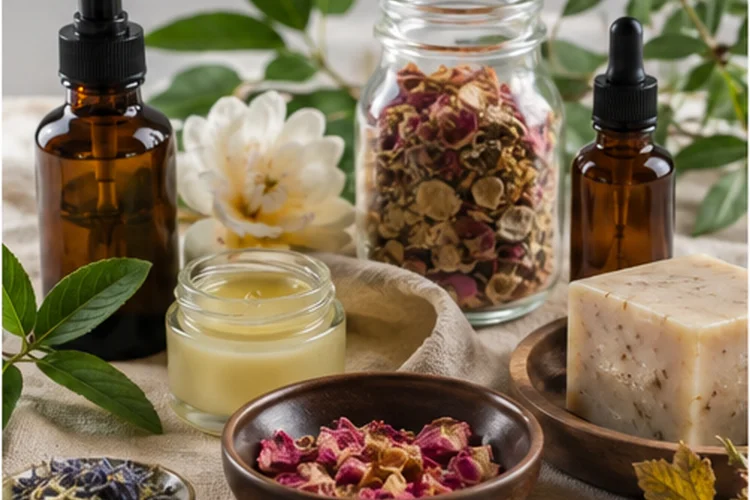
Long before bathroom shelves were filled with serums, conditioners, scalp treatments, and moisturizers, people were already experimenting with plants for personal care.
Aloe gel was applied to the skin, aromatic leaves were infused into oils, flowers were added to washes, and herbs were used to scent and condition the hair.
That history helps explain why botanical ingredients remain so popular in modern beauty products.
Understanding how herbal traditions use plants in skin and hair care is not simply about collecting old remedies.
It also offers an interesting way to study plant chemistry, extraction methods, cultural practices, and the difference between traditional experience and modern clinical evidence.
Some plants, including aloe vera, calendula, tea tree, chamomile, and rosemary, have been investigated scientifically.
However, the amount and quality of research vary considerably, and a plant’s traditional reputation does not automatically prove that every homemade preparation works.
The best approach is curious but cautious: learn the tradition, examine the evidence, and respect the skin as a sensitive biological barrier.
Why Plants Became Part of Traditional Personal Care
Plants were practical ingredients for early personal-care traditions because they were locally available and could be prepared in many ways.
Leaves and flowers could be steeped in water. Seeds could provide oils. Aromatic plants could scent baths and hair preparations, while thicker plant gels could be spread directly over the skin.
Different cultures naturally developed different approaches based on local vegetation and medical traditions.
Over time, certain herbs became associated with particular uses: soothing dry skin, cleansing oily areas, scenting hair, massaging the scalp, or making protective salves.
Modern science examines these traditions differently. Researchers can analyze plant constituents, study how extracts interact with skin cells, and test specific products in controlled trials.
That scientific process is important because historical use tells us what people did, but it does not always tell us how effective or safe the practice actually was.
Aloe Vera Is a Classic Skin-Care Plant
Few botanical ingredients are as closely associated with skin care as aloe vera.
The clear gel inside aloe leaves has a long history of topical use and now appears in countless moisturizers, after-sun products, gels, and cosmetic formulations.
NCCIH reports that topical aloe gel is generally well tolerated. However, some people experience burning, itching, rash, or eczema after application.
Research on specific medical uses has also produced mixed results rather than proving aloe useful for every skin condition.
That distinction matters.
Using an aloe-containing moisturizer because it feels pleasant is different from claiming that aloe can treat psoriasis, burns, infections, or serious wounds.
Commercial products may also contain much more than aloe. Preservatives, fragrances, thickeners, and other ingredients can influence how the final product behaves on the skin.
For herbal students, aloe provides an excellent lesson: even a familiar and apparently simple plant product needs context.
Calendula Shows How Flowers Enter Topical Herbalism
Calendula, or Calendula officinalis, is another classic plant in European topical herbal traditions.
Its bright orange or yellow flowers have traditionally been incorporated into infused oils, creams, ointments, and washes.
The European Medicines Agency recognizes certain calendula-flower preparations for traditional use in minor skin inflammation and as an aid in the healing of minor wounds. These conclusions are based substantially on long-standing traditional use.
That does not mean every jar of homemade calendula oil has identical properties.
The species, flower quality, carrier oil, extraction method, concentration, cleanliness, and storage conditions can all influence the finished preperation.
Calendula is especially useful for teaching the difference between a plant and a defined herbal preparation.
When a regulatory monograph discusses a particular calendula product, its conclusions cannot automatically be applied to every soap, homemade salve, or cosmetic containing a few flower petals.
Chamomile Is Used for More Than Bedtime Tea
Chamomile is usually associated with relaxing evening drinks, but it also has a history of external use.
German and Roman chamomile have appeared in washes, creams, compresses, hair rinses, and other traditional preparations.
NCCIH notes that topical use of chamomile may be safe at appropriate doses over the short term, although allergic reactions remain possible.
The allergy issue is particularly important.
Chamomile belongs to the Asteraceae family, which also includes plants such as ragweed and chrysanthemums. People sensitive to related plants may be more likely to react.
This shows why “gentle herb” can be misleading.
A plant can smell mild, look delicate, and have centuries of traditonal use while still causing an unwanted skin reaction in a particular person.
Botanical products should be judged by actual safety information, not by how soft or natural their marketing appears.
Tea Tree Oil Represents Concentrated Herbal Skin Care
Tea tree oil is very different from an infused herbal oil.
It is an essential oil distilled from Melaleuca alternifolia, producing a highly concentrated aromatic preparation. Tea tree oil appears in products marketed for oily skin, blemishes, scalp care, and other topical purposes.
NCCIH reports that some research supports topical tea tree oil for acne and athlete’s foot, but evidence for many other promoted uses remains limited.
It also warns that topical tea tree oil can cause redness and skin irritation, particularly when products have deteriorated through exposure to heat, light, or air.
Tea tree oil should not be swallowed because oral ingestion can cause serious toxicity.
This makes it a good example of why essential oils should never be treated like ordinary culinary herbs.
A few drops of concentrated essential oil are chemically very different from a cup of herbal tea or a jar of leaves infused into olive oil.
Herbal Oils Connect Skin Care and Hair Care
Infused oils are among the simplest traditional ways to prepare plants for external use.
Dried flowers or leaves may be placed in a carrier oil such as olive or sunflower oil, allowing oil-soluble compounds to move gradually into the liquid. The strained oil can then become part of massage oils, scalp products, balms, or cosmetic formulations.
Traditional hair practices often use oils for a very practical reason: oil can coat hair fibers, reduce friction, add shine, and make hair feel softer.
When herbs are added, the preparation also gains aroma and plant-derived constituents.
However, herbal oil, carrier oil, and essential oil are three differnt things.
An infused rosemary oil may contain plant material extracted into a carrier oil. Rosemary essential oil is a concentrated aromatic product. A commercial “rosemary hair oil” might contain either one—or a mixture of many ingredients.
Reading the ingredient list is therefore far more informative than relying on the name printed across the front of the bottle.
Rosemary Has Become Popular in Modern Hair Care
Rosemary has become one of the most heavily promoted botanical ingredients for scalp and hair products.
There is some human research behind the interest. A 2015 randomized comparative trial involving people with androgenetic alopecia compared rosemary oil with 2 percent minoxidil over six months.
Both groups showed increased hair counts at six months, with no significant difference between them in that study.
That finding is interesting, but it should not be exaggerated.
One study does not establish rosemary oil as universally equivalent to established hair-loss treatments. The trial involved a specific population and formulation, and additional high-quality research is needed before broad claims can be made.
Hair loss also has many possible causes, including genetics, hormonal changes, nutrient problems, medications, autoimmune conditions, illness, and scalp disorders.
A pleasant rosemary scalp oil might fit into a personal-care routine, but unexplained or rapidly progressing hair loss deserves proper evaluation rather than endless experimentation with herbal products.
Plant Extracts Can Influence How Products Feel
Not every botanical ingredient in skin or hair care is included because it supposedly treats a condition.
Plants can influence colour, scent, texture, lubrication, and the overall sensory experience of a product.
Lavender is a good example.
Its fragrance has made it popular in soaps, oils, shampoos, lotions, and bath products. However, NCCIH notes that topical lavender-containing products can cause allergic skin reactions in some people.
FDA makes a broader point about botanical cosmetics: an ingredient being derived from a plant does not guarantee that it is safe on the skin.
Some plant substances can be irritating, allergenic, or photosensitizing. Certain citrus oils, for example, can create problems when skin is exposed to sunlight.
So botanical fragrance should be treated as an ingredient with chemistry-not simply as “nature in a bottle.”
Traditional Preparation Methods Change the Final Product
One reason herbal skin and hair care can become confusing is that the same plant may appear in completely different forms.
Consider rosemary.
You could prepare a water infusion from its leaves, make an infused carrier oil, use a manufactured extract, or work with diluted rosemary essential oil. Each preparation extracts a different mixture and concentration of plant compounds.
The same principle applies to calendula, chamomile, lavender, and many other herbs.
Processing therefore matters just as much as plant identity.
Heating, drying, distillation, alcohol extraction, oil maceration, and water infusion can all produce different chemical profiles.
This is why research involving one standardized extract cannot automatically prove that another form works the same way.
Whenever you read a claim such as “studies show this herb works,” ask what researchers actually used.
Was it a cream? Essential oil? Standardized extract? Infused oil? Gel?
That one question can expose a surprising amount of misleading marketing.
Natural Does Not Mean Hypoallergenic
One of the biggest myths in botanical beauty is that plant-based products are automatically suitable for sensitive skin.
FDA notes that cosmetics-including products containing fragrances and botanical substances-can trigger allergic reactions in some people.
An ingredient can be natural and still irritate skin.
Tea tree oil may cause redness. Lavender products can cause allergic reactions. Aloe occasionally causes itching or rash. Chamomile can be problematic for people with certain plant allergies.
Essential oils deserve particular care because they are concentrated.
Do not assume that applying them undiluted makes them work faster. Higher concentration can simply increase irritation risk.
When introducing a new topical botanical product, use it carefull and stop if you develop significant redness, swelling, burning, blistering, or itching.
Severe reactions or persistent skin problems deserve professional medical assessment.
Cosmetic Care Is Different From Medical Treatment
The difference between beauty care and medical claims is important both scientifically and legally.
In the United States, FDA explains that whether a product is considered a cosmetic, drug, or both depends largely on its intended use and the claims made for it.
A product intended to beautify or condition skin may be a cosmetic, while one marketed to treat disease can fall under drug requirements.
This matters when discussing herbal products online.
Saying that a calendula oil “feels soothing on dry skin” is not the same claim as saying it “cures dermatitis.” Describing rosemary oil as part of a scalp-care routine is different from promising that it will reverse every type of baldness.
Responsible herbal education keeps those boundaries visible.
It also recognizes that skin conditions such as severe acne, eczema, infections, unexplained rashes, or persistent hair loss may need diagnosis and evidence-based treatment.
Herbal traditions can contribute interesting ideas without needing to replace modern dermatology.
Plants have played a role in skin and hair care for generations, from aloe gels and calendula oils to chamomile washes, aromatic lavender products, tea tree preparations, and rosemary scalp oils.
These traditions offer fascinating examples of how people learned to extract, scent, soften, cleanse, and condition using botanical materials.
Modern research provides support for some specific preparations, while evidence for many popular claims remains incomplete. Safety also matters because natural ingredients can still irritate skin, trigger allergies, or become problematic when overly concentrated.
If you want to explore herbal personal care, start with one plant. Learn its botanical identity, traditional preparation, modern evidence, and known risks before adding it to your routine.
That approach turns herbal beauty from a trend into genuine plant knowledge.