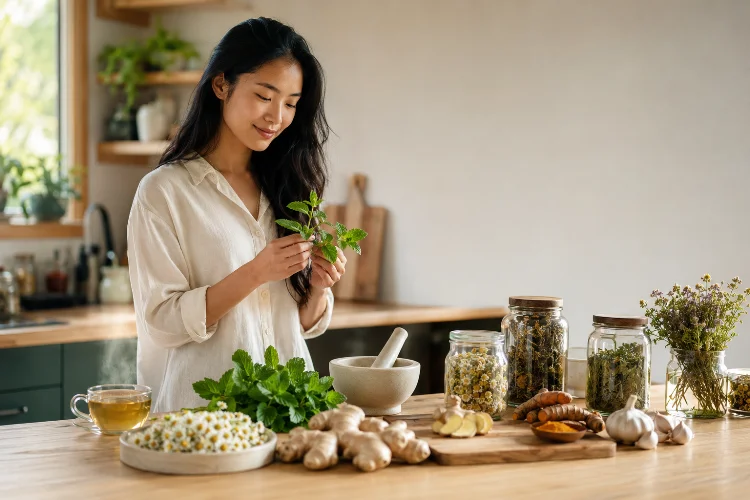
Imagine opening your kitchen cupboard and finding chamomile, ginger, peppermint, turmeric, or garlic. Most people think of these plants as ingredients for tea or cooking, but plants have also been used in health traditions for thousands of years.
That is where herbalism comes in.
Herbalism is the practice of using plants and plant-based preparations to support health and well-being.
Depending on the culture and tradition, people may use leaves, flowers, roots, bark, seeds, fruits, or other plant parts in teas, extracts, powders, capsules, oils, and topical preparations.
The idea can sound simple, but herbal medicine is a much bigger subject than drinking a cup of herbal tea when you feel unwell. It combines traditional knowledge, plant identification, preparation methods, safety considerations, and increasingly, scientific research.
For complete beginners, the most important thing is understanding both sides of herbalism: why people have valued medicinal plants for generations and why “natural” does not automatically mean safe or scientifically proven.
What Is Herbalism?
At its simplest, herbalism involves using plants for therapeutic or health-related purposes. Someone practicing herbalism may study medicinal plants, their traditional uses, preparation methods, potential effects, and safety.
Herbal medicine is part of many traditional healthcare systems around the world.
The World Health Organization describes traditional medicine as systems of knowledge, skills, practices, and philosophies that developed in different historical and cultural settings, often before modern biomedicine.
However, herbalism is not one single standardized system. European herbal traditions, Ayurveda, Traditional Chinese Medicine, Indigenous healing traditions, and local folk medicine may all use plants differently.
Modern herbalists may also combine traditonal knowledge with published scientific research rather than relying entirely on historical use.
Herbalism Has a Very Long History
Humans were experimenting with plants long before modern pharmacies existed. Different societies gradually learned which plants could be eaten, which caused unwanted effects, and which appeared useful for particular health problems.
Some of this traditional knowledge eventually contributed to modern drug development. WHO highlights examples including artemisinin and aspirin as medicines with roots in traditional medicine and natural-product knowledge.
That does not mean using a plant is the same as taking a modern pharmaceutical made from or inspired by it.
A pharmaceutical medicine normally contains carefully measured active ingredients and undergoes controlled testing, while a whole herb may contain many different chemical compounds in varying concentrations.
This distinction is one of the most important things for a begginer to understand.
How Can Medicinal Herbs Affect the Body?
Plants manufacture thousands of natural chemicals. Some help defend the plant against insects, disease, sunlight, or environmental stress, while others influence color, smell, or flavor.
When humans consume medicinal plants, certain compounds may interact with processes inside the body. This is one reason researchers study substances such as polyphenols, alkaloids, terpenes, flavonoids, and other plant constituents.
But the presence of biologically active chemicals does not automatically prove that a herb treats a disease.
Research on herbal products varies enormously. Some herbs have been studied in clinical trials, while others mainly have a history of traditional use.
NCCIH therefore provides individual research summaries for popular plants because evidence about effectiveness and safety differs from herb to herb.
In other words, asking “Does herbal medicine work?” is too broad. A better question is: Does this particular herb, in this particular preperation and dose, have evidence for this particular purpose?
What Forms Does Herbal Medicine Take?
Herbal medicine is not limited to dried leaves in glass jars. MedlinePlus notes that herbal products may be available as fresh or dried plants, teas, powders, extracts, tablets, and capsules.
One of the simplest preparations is an infusion, which is similar to making tea. Hot water is poured over plant material such as leaves or flowers and allowed to steep.
Roots and bark may sometimes be prepared as a decoction, where tougher plant material is simmered in water. Herbal extracts or tinctures use a liquid such as alcohol or another solvent to extract plant compounds.
You may also encounter capsules, powders, syrups, infused oils, creams, salves, and other topical products.
These forms are not automatically interchangeable. The amount and concentration of plant compounds can vary considerably depending on preparation, extraction, processing, storage, and dosage.
What Do People Use Herbs For?
People turn to medicinal plants for many different reasons. Some use simple herbal teas as part of their everyday wellness routine, while others use herbal products hoping to manage particular symptoms.
Commonly known examples include ginger, peppermint, chamomile, turmeric, echinacea, ginseng, garlic, and St. John’s wort. However, their evidence, recommended uses, potential side effects, and interactions are very different.
This is where careful research becomes essential.
A long history of use can provide useful clues, but it is not the same as strong clinical evidence. Likewise, one positive laboratory experiment does not prove that a plant will produce the same effect in humans.
MedlinePlus and NCCIH both maintain databases where consumers can check research, possible uses, side effects, and interactions for individual herbs and supplements.
Is Herbalism Safe?
Herbal remedies can sometimes seem gentle because they come from plants. Unfortunately, “natural” and “risk-free” are not synonyms.
Herbs may cause allergic reactions, digestive problems, changes in blood pressure, liver problems, or other unwanted effects.
They may also interact with prescription medicines, over-the-counter drugs, or other supplements. NCCIH specifically warns that herbal supplements can interact with medicines and create additional risks for people with certain medical conditions or those preparing for surgery.
St. John’s wort is a classic example. NCCIH notes that it interacts with many medicines because it can affect how drugs are processed in the body.
Product quality matters as well. In the United States, dietary supplements are regulated differently from conventional drugs, and FDA does not approve them for safety and effectiveness before they reach the market.
Pregnant or breastfeeding people, children, people with liver or kidney problems, and anyone taking regular medicines should be particularly cautious.
NHS guidance also recommends discussing herbal medicine with an appropriate healthcare professional in situations where interactions or medical conditions may be relevant.
Herbalism vs Modern Medicine
Herbalism and conventional medicine do not necessarily need to be treated as enemies.
Modern medicine relies heavily on controlled research, standardized dosages, diagnostic testing, pharmacology, and carefully evaluated treatments. Herbal practices may offer cultural knowledge and plant-based approaches that researchers can investigate scientifically.
The most sensible approach is usually evidence-aware rather than choosing one side simply because it feels more “natural” or more “scientific.”
WHO describes integrative medicine as an evidence-based approach that can combine biomedical knowledge with appropriate traditional or complementary practices.
Importantly, herbal products should not be used to delay proper diagnosis or replace proven treatment for serious medical conditions without professional medical guidance.
How Can Beginners Start Learning Herbalism?
You do not need to purchase dozens of mysterious bottles to start learning. In fact, a slower approach is often much more useful.
Begin with one or two familiar plants and learn their botanical names, traditionally used plant parts, preparation methods, known evidence, potential side effects, and drug interactions.
Comparing information from reputable medical databases with traditional herbal literature can also help you understand where evidence is strong, uncertain, or missing.
Keep notes about what you learn instead of relying on social media claims. Most importantly, rember that dosage, preparation, plant species, and personal health conditions can completely change the safety profile of an herbal product.
If you eventually want to practise herbalism seriously, studying basic botany, human anatomy, physiology, pharmacology, and plant safety can provide a much stronger foundation than simply memorizing lists of “herbs for symptoms.”
Herbalism is the practice of using plants and plant preparations to support health, and its roots stretch across many cultures and centuries.
From simple herbal teas to concentrated extracts, medicinal plants remain widely used today and continue to attract scientific interest.
But responsible herbalism requires more than assuming that plants are automatically safe. Evidence varies from one herb to another, products can differ in strength and quality, and some herbs can interact seriously with medications.
If you are curious about herbal medicine, start small. Choose one plant, investigate both its traditional use and modern research, check reputable safety information, and speak with a qualified healthcare professional before using concentrated herbal products for a medical condition.
The best introduction to herbalism is not collecting as many herbs as possible-it is learning how to evaluate them wisely.