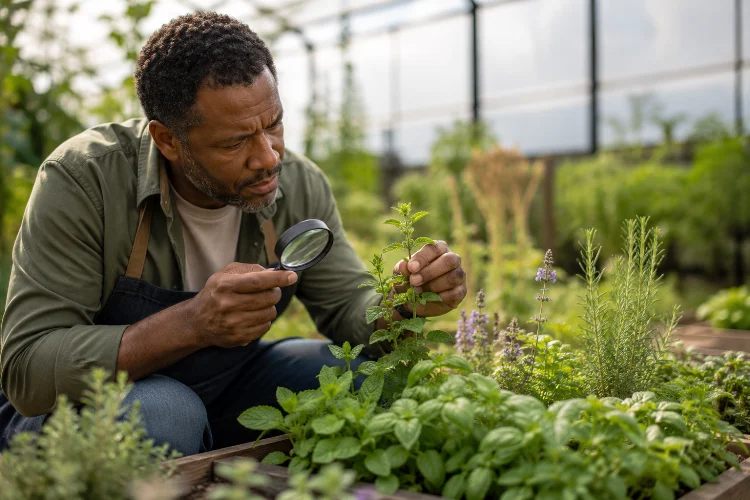
Have you ever looked at a green plant in a garden and wondered whether it was mint, basil, oregano, or simply a weed?
At first, many herbs can look surprisingly similar. Once you know what details to examine, however, plant identification becomes much easier.
Learning how to identify common herbs by leaves, flowers, and stems is a useful skill for gardeners, home cooks, and anyone interested in herbalism.
You do not need to become a professional botanist to notice basic characteristics such as leaf shape, texture, arrangement, stem structure, flower color, and growth habit.
The key is not relying on a single clue. A plant with needle-like leaves is not automatically rosemary, just as a plant with a square stem is not automatically mint. Good identification comes from combining several features.
This beginner-friendly guide explains the main botannical clues to observe and shows how they appear in familiar herbs such as basil, mint, rosemary, thyme, sage, and cilantro.
Start by Looking at the Whole Plant
Before examining individual leaves, take a moment to look at the entire plant.
Is it tall and upright, compact and bushy, creeping across the ground, or forming woody branches? Growth habit is often one of the easiest clues to notice.
For example, common thyme is generally a small, low-growing perennial with a fine texture, while rosemary can develop into a much larger woody shrub.
Spearmint grows upright but also spreads aggressively through underground rhizomes and stems that may root when they touch the ground.
The University of Minnesota notes that many familiar culinary herbs-including basil, oregano, mint, rosemary, thyme, and sage-belong to the mint family, Lamiaceae.
These plants often share characteristics such as aromatic foliage, which explains why beginners can sometimes confuse them.
The overall shape gives you your first clue. The smaller details help confirm it.
Identify Herbs by Their Leaves
Leaves are usually the most useful place to start because they remain visible for much longer than flowers.
1. Check the Leaf Shape
Ask whether the leaves are round, oval, narrow, needle-like, deeply divided, or somewhere in between.
Rosemary is one of the easiest examples. Its leaves are narrow and needle-like and grow opposite each other along the stem. Older plants also develop woody branches, creating a shrub-like appearance that is quite different from soft leafy herbs.
Sage looks almost completely different. Common sage typically has broader oval leaves with a gray-green color and a noticeably fuzzy surface. The texture alone can become a very distictive clue once you have handled the plant a few times.
Thyme has much smaller leaves than either rosemary or sage. Common thyme normally forms a compact, finely textured plant, so its tiny leaves and small woody stems are helpful identification features.
2. Notice How Leaves Are Arranged
Do not only look at an individual leaf. Look at how the leaves connect to the stem.
Leaves may appear opposite each other, alternate from side to side, or form other arrangements. Opposite leaves are especially common among members of the mint family.
This helps explain why basil, mint, rosemary, sage, and thyme can share certain structural similarities even when the individual leaves look very different.
Leaf arrangement is best treated as one piece of evidence rather than a final answer.
Examine the Stems Carefully
Stems are often overlooked, but they can provide excellent identification clues.
Spearmint, for example, has square stems. This characteristic is strongly associated with the mint family, although square stems alone should never be considered proof that a plant is edible mint.
NC State also notes that spearmint spreads through rhizomes and that its stems can root where they contact the soil.
Stem texture can also reveal the age and growth style of the plant. Basil usually has softer green growth, particularly when young, while rosemary and thyme can become woody as they mature.
Sage offers another useful clue. Its gray-green leaves are attached oppositely to stems that may have noticeable hairs.
When studying a stem, look at its shape, color, texture, branching pattern, and whether it feels soft or woody. These characteristics can quickly narrow down your identifcation options.
Use Flowers as an Extra Identification Clue
Flowers are extremely helpful when they are available because flower structure is often more consistent than leaf appearance.
Spearmint produces small flowers that may be lilac, pink, or white and are arranged in terminal spikes. Sage also produces flowers along spikes, with common sage typically developing lavender-colored, tubular, two-lipped blooms.
Rosemary commonly produces small pale-blue flowers with a two-lipped form, although flowering characteristics may vary somewhat among cultivars.
Cilantro becomes particularly interesting once it flowers. When the plant bolts, it sends up stems carrying clusters of small white flowers arranged in umbrella-like structures known as umbels. Its mature seeds are what we commonly call coriander.
Flower structure can therefore provide an important second or third piece of evidence when leaves alone are not enough.
How to Recognize Five Common Culinary Herbs
Several popular herbs have combinations of characteristics that beginners can learn quite quickly.
1. Basil
Sweet basil usually has soft, fragrant leaves and a bushy growth habit. Pinching the growing tips encourages branching, which is why regularly harvested basil plants often become fuller and more compact. Basil belongs to the Lamiaceae or mint family.
Different cultivars can vary considerably. Genovese basil may look different from Thai basil or purple basil, so color alone should not be your deciding factor.
2. Mint
Spearmint typically has bright green aromatic leaves, square stems, and an upright growth habit. It spreads rapidly, which is another useful clue when you find a patch that seems determined to take over a garden bed.
Its small flowers eventually appear in spikes, often in shades of lilac, pink, or white.
3. Rosemary
Rosemary is much easier to recognize when mature. Look for narrow, opposite, needle-like leaves attached to branches that become woody over time.
Its small pale-blue flowers provide another useful clue when the plant is blooming.
4. Sage
Common sage has soft-looking gray-green foliage with oval leaves and a slightly fuzzy or textured surface.
Lavender flower spikes can appear when the plant blooms, making the combination of fuzzy leaves and purple-toned flowers particularly useful for recognition.
5. Thyme
Common thyme is usually much smaller and finer than rosemary. It is a low-growing perennial that may develop woody growth and produces small flowers that attract pollinators.
Rather than looking for one dramatic characteristic, identify thyme through the combination of tiny leaves, compact growth, aroma, and slender stems.
Smell Can Help, but Do Not Depend on It
Aroma can be extremely useful with cultivated culinary herbs.
Gently rubbing a known mint leaf, for example, releases its familiar fragrance. Rosemary, basil, sage, and thyme also have strong aromas that can help experienced gardeners distinguish them.
However, smell should be supporting evidence rather than your main identification method. Different species can produce similar scents, and scent perception varies from person to person.
More importantly, avoid crushing or handling an unknown wild plant simply to smell it. Some potentially dangerous plants can irritate the skin or cause other problems.
Visual observation should always come first.
Be Careful With Look-Alikes
This is where herb identification becomes more serious.
Some harmless or edible plants can resemble toxic species. Plants in the parsley or carrot family deserve particular caution because several species have similar finely divided leaves and umbrella-shaped flower clusters.
Poison hemlock, for instance, is highly toxic. The University of Minnesota describes it as having smooth, hollow green stems with purple spots, deeply divided fern-like leaves, and clusters of small white flowers in umbrella-shaped formations. All parts of the plant are poisonous if ingested.
This does not mean you should attempt to identify edible wild herbs merely by checking that they do not match those features.
Never eat an unknown wild plant based only on a photograph, mobile app, smell, or one article. Confirmation using multiple reliable sources—and, when necessary, an experienced local botanist, horticulturist, or qualified foraging expert-is much safer.
A Simple Beginner Method for Herb Identification
When you encounter an unfamiliar herb, work through the plant systematically rather than guessing immediately.
First, notice the plant’s overall size and growth habit. Then examine the leaves: their shape, color, texture, edges, size, and arrangement along the stem.
Next, inspect the stem. Is it round or square? Hairy or smooth? Green and tender or hard and woody?
If flowers are present, examine their color, shape, number of petals, and how they are arranged. Finally, compare several features with a reputable botanical reference.
Taking clear photographs can also help. Capture the entire plant, then seperate images of the leaves, stem, flowers, and where the plant is growing.
This approach trains you to observe patterns rather than simply trying to recieve an instant answer from a plant-identification app.
Learning how to identify common herbs becomes much easier once you stop viewing every plant as simply “green leaves.” Leaf shape and arrangement, stem structure, flower patterns, texture, aroma, and growth habit all provide useful clues.
Basil may have soft fragrant foliage, mint commonly combines aromatic leaves with square stems, rosemary has needle-like leaves and woody branches, sage has fuzzy gray-green foliage, and thyme remains compact with tiny leaves.
The most important rule is to use several characteristics together. Never consume an unfamiliar wild plant based on appearance alone.
Start with herbs you already grow or buy regularly. Study one plant closely each week, photograph its different parts, and compare what you see with trusted botanical sources. Before long, recognizing common herbs will begin to feel surprisingly natural.