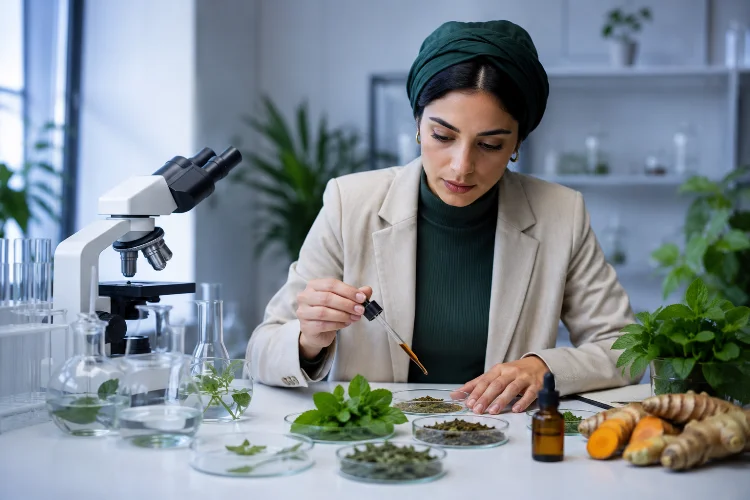
When people first study herbalism, they often learn simple associations: peppermint contains menthol, turmeric contains curcumin, or ashwagandha contains withanolides.
It can quickly sound as though every medicinal plant has one special chemical responsible for everything the herb does. Modern herbal education is more complicated-and much more interesting.
The term active constituents generally refers to chemical substances in a plant that are believed or known to contribute to biological or therapeutic activity.
However, herbs are complex mixtures containing many compounds, and researchers do not always know which substances are responsible for a particular effect.
The U.S. FDA even notes that botanical drug products may lack a clearly identified active ingredient because of their chemical complexity.
Understanding active constituents therefore helps students connect traditional herbal knowledge with phytochemistry, pharmacology, quality control, and modern scientific evidence.
This guide explains what the term really means, why it matters, and why herbal education should never reduce an entire plant to a single molecule.
What Are Active Constituents in Herbs?
A medicinal plant contains many naturally occurring chemical substances. In herbal science, these substances are often called constituents, phytochemicals, or plant compounds.
WHO describes constituents as chemically defined substances or groups of substances found in herbal materials or herbal preparations.
Some of these compounds may contribute to biological activity, while others may primarily influence characteristics such as aroma, color, stability, or plant defense.
Common classes of plant constituents include alkaloids, flavonoids, tannins, terpenes, saponins, phenolic compounds, and volatile oils.
An “active constituent” usually receives that label because evidence suggests that it contributes to a pharmacological or therapeutic effect. That does not necessarily mean it is the only important chemical in the plant.
This distinction is essential in modern herbal education.
One Herb Can Contain Hundreds of Compounds
Plants are chemically complex organisms rather than containers holding one medicinal ingredient.
Take turmeric as an example. Curcumin receives enormous attention, but it belongs to a wider group called curcuminoids.
NCCIH explains that many health-related activities associated with turmeric are commonly attributed to these compounds, while also noting that current evidence is not sufficient to make definitive conclusions about turmeric or curcumin for most health purposes.
This illustrates an important educational principle: identifying a chemical compound is not the same as proving a clinical effect.
Students therefore need to learn several layers of information. They may study which compounds occur in a plant, what those compounds do in laboratory experiments, how they are absorbed by the body, and whether clinical studies show meaningful benefits in real people.
That progression prevents herbal chemisty from becoming an oversimplified list of “compound equals effect.”
Active Constituents Are Not Always Fully Known
In conventional pharmaceutical education, students often learn about medicines with clearly defined active ingredients. A tablet might contain a precise quantity of one chemical molecule with a well-characterized mechanism.
Herbal preparations can be different.
FDA describes botanical drugs as complex mixtures and specifically recognizes that they may sometimes lack a distinct active ingredient.
Similarly, the European Medicines Agency notes that active constituents in many herbal medicinal products are generally less well defined than those in conventional chemical medicines.
This means teachers should be careful with phrases such as “the active ingredient in this herb is X.”
Sometimes that statement may be reasonable. In other cases, researchers may only know that several compounds appear pharmacologically relevant, while the full biological activity remains uncertain.
A more accurate approach is often to say that a plant contains constituents associated with certain biological activities.
That wording reflects the actual limits of available evidence.
Active Constituents vs Marker Compounds
One of the most useful concepts for herbal students is the difference between an active constituent and a marker compound.
A marker is a measurable chemical used to help identify, compare, or control the quality of herbal material. Importantly, a marker does not automatically cause the herb’s therapeutic effect.
WHO explains that marker substances may or may not contribute to therapeutic activity, and even when they do, there may be insufficient evidence that they alone are responsible for clinical efficacy.
Imagine a manufacturer testing batches of an herbal extract. Measuring a particular marker can help determine whether different batches contain a reasonably consistent chemical profile.
That is valuable for quality control, but it does not prove that the marker is the only medically relevant compound.
Modern herbal education should make this difference very clear because product labels sometimes make chemical standarization look simpler than it actually is.
Why Constituents Matter for Herbal Quality Control
Two products carrying the same herb name may not necessarily have identical chemical compositions.
Plant species, growing conditions, harvesting time, storage, processing, extraction solvent, temperature, and manufacturing methods can influence the final preparation.
FDA guidance for botanical drug development therefore considers botanical identity, extraction methods, chemical constituents, manufacturing controls, and batch consistency important parts of product evaluation.
WHO also stresses that herbal materials and preparations are chemically complex and that measuring marker substances alone is not enough to guarantee overall product quality. Good agricultural, collection, and manufacturing practices are also important.
For students, this introduces a useful lesson: the name of the herb is only the beginning.
You may also need to know the botanical species, plant part, type of preparation, extraction method, chemical profile, and product quality before two herbal products can meaningfully be compared.
Extraction Changes What Constituents You Get
A cup of herbal tea and a concentrated alcohol extract made from the same plant are not chemically identical.
Different compounds dissolve more easily in different solvents. Water may extract some substances efficiently, while ethanol or other solvents may extract a somewhat different chemical profile.
EMA describes herbal preparations as products created through processes such as extraction, distillation, expression, fractionation, purification, concentration, and fermentation.
This is why modern students should avoid thinking of “the herb” as one fixed substance.
Preparation matters.
For example, research conducted using a particular standardized extract cannot automatically be applied to every tea, powder, capsule, or homemade tincture containing the same species.
NCCIH similarly cautions that supplements sold commercially may differ substantially from products used in scientific studies.
Understanding this makes it easier to interpet herbal research correctly.
How Scientists Study Herbal Constituents
Modern herbal research combines several scientific disciplines.
Pharmacognosy studies medicines and biologically active substances obtained from natural sources. Phytochemistry focuses more specifically on plant chemicals, while pharmacology examines how substances interact with biological systems.
Researchers may use analytical techniques such as high-performance liquid chromatography, gas chromatography, mass spectrometry, and chemical fingerprinting to separate, identify, and measure plant constituents.
WHO lists chromatographic and spectrometric methods among important approaches used in herbal quality analysis.
Scientists may then investigate individual chemicals or entire extracts in laboratory models.
Later studies may explore safety, absorption, metabolism, dosage, and clinical outcomes. Each stage answers a different question, so promising laboratory results should not automatically be treated as evidence that an herb will treat a disease in humans.
This is one reason good herbal education teaches students to ask what kind of evidence supports a claim, rather than simply whether research exists.
Why the “One Herb, One Chemical” Model Can Be Misleading
It is tempting to learn herbal medicine in the same way people memorize conventional medications.
Herb A contains compound B, therefore compound B explains effect C.
Reality is rarely that tidy.
WHO specifically notes that, because herbal medicines are complex, it is unlikely that a single compound is always solely responsible for therapeutic activity.
Several constituents might act independently, contribute to different effects, change one another’s absorption, or simply coexist without having clinically important activity.
Researchers sometimes investigate possible synergistic effects, but synergy should not be assumed without evidence either.
The better educational model is to consider the whole chemical profile while still studying individual constituents.
That allows students to appreciate traditional whole-plant preparations without rejecting the value of modern chemical analysis.
Active Constituents Also Matter for Safety
Studying constituents is not only about potential benefits.
Plants can contain pharmacologically active substances capable of causing side effects or interacting with medicines.
NCCIH warns that herbal supplements may interact with medications and may pose additional risks for people with certain health conditions or those preparing for surgery.
The chemical concentration also matters. A mild tea and a highly concentrated extract may expose someone to very different amounts of particular constituents.
For this reason, students should learn pharmacology, toxicology, herb-drug interactions, dosage concepts, and product quality alongside traditional indications.
Knowing the name of an “active compound” without understanding its safety profile gives only part of the picture.
What Beginners Should Learn From Active Constituents
For beginners, there is no need to memorize hundreds of molecules immediately.
A better approach is to choose one herb and study it in layers. Learn its correct botanical name and plant part first.
Then examine its major known phytochemical groups, important marker compounds, studied biological activities, preparation methods, clinical evidence, and safety concerns.
You might study turmeric, for example, and encounter curcuminoids. With ashwagandha, you may come across withanolides; NCCIH identifies these among the plant’s bioactive compounds.
The goal is not simply chemical memorization.
It is understanding how plant identity, constituents, preparation, evidence, measurment, and safety connect.
Once that framework becomes familiar, reading herbal monographs and scientific papers becomes considerably easier.
Active constituents are an important bridge between traditional herbal knowledge and modern plant science.
They help students understand why medicinal plants may have biological activity, how researchers study them, and how herbal products can be evaluated for consistency and quality.
However, an herb should not automatically be reduced to one famous molecule. Botanical preparations often contain complicated mixtures, active compounds may be uncertain, and marker chemicals do not always represent the entire therapeutic action.
If you are beginning herbal studies, focus on understanding relationships rather than memorizing chemical names. Choose one familiar herb, explore its constituents, preparation methods, evidence, and safety profile, then repeat the process with another plant.
That approach builds a much stronger foundation for modern, evidence-aware herbal education.