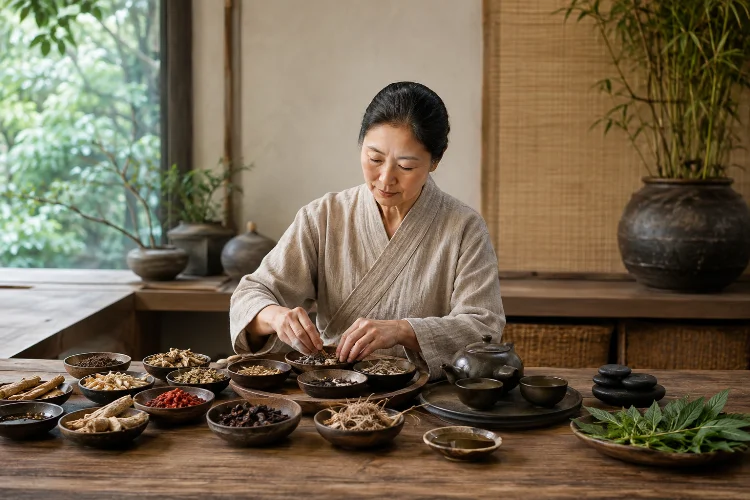
Why might two people with similar symptoms receive completely different herbal recommendations in a traditional healing system? The answer often comes down to one important idea: balance.
Many traditional herbal systems do not begin by looking at a single symptom in isolation. Instead, they consider broader patterns involving digestion, sleep, energy, emotions, diet, environment, season, constitution, and lifestyle.
Health is often understood as a dynamic state in which different parts of life and the body remain in an appropriate relationship.
The World Health Organization describes traditional medicine as knowledge, practices, skills, and philosophies that developed in different historical and cultural settings.
It also notes that these traditions commonly emphasize personalized and holistic approaches intended to restore balance between mind, body, and environment.
Understanding how traditional herbal systems understand health and balance does not require accepting every traditional explanation as modern biological fact.
Instead, it helps us understand the frameworks through which generations of healers observed health, illness, food, plants, and daily life.
What Does “Balance” Mean in Traditional Herbal Medicine?
Balance can sound vague until you understand how traditional systems use the idea.
In many traditions, health is not simply defined as the absence of disease. Practitioners may look at how well different physical, mental, environmental, and lifestyle factors are functioning together.
WHO specifically characterizes traditional medicine as frequently taking holistic and personalized approaches to restoring balance among mind, body, and environment.
This means that fatigue, for example, might not automatically be viewed as an isolated problem. A traditional assessment may consider appetite, digestion, sleep, emotional stress, physical activity, climate, age, and other characteristics.
Different systems explain these relationships in different ways.
Ayurveda uses concepts that developed within the Indian medical tradition. Traditional Chinese Medicine has its own frameworks involving ideas such as yin and yang. Other regional traditions developed their own classifications of plants, constitutions, qualities, and patterns.
These concepts should be understood within their historical and cultural systems rather than treated as interchangeable terms.
Ayurveda and the Idea of Individual Constitution
Ayurveda is one of the world’s long-standing traditional medical systems and developed in India. According to NCCIH, it takes a natural and holistic approach to physical and mental health and may incorporate plant-based products, diet, exercise, and lifestyle practices.
A central idea in Ayurvedic thinking is that people differ in constitution and therefore may not respond to foods, environments, routines, or treatments in exactly the same way.
Understanding the Doshas
Ayurvedic teaching traditionally describes three organizing principles known as Vata, Pitta, and Kapha, often referred to as doshas.
These concepts are used within Ayurveda to describe patterns and tendencies rather than simply functioning as names for particular organs or biomedical substances.
Someone studying Ayurveda may therefore learn to observe features such as digestion, temperature preferences, sleep, appetite, emotional tendencies, and physical characteristics when considering overall patterns.
The purpose is not necessarily to ask, “Which herb treats this symptom?” Instead, the traditonal question may be closer to, “What pattern of imbalance is present in this particular person?”
That emphasis on individuality is one reason Ayurvedic recommendations can include lifestyle and dietary changes alongside herbal preparations.
Traditional Chinese Medicine and Yin-Yang Balance
Traditional Chinese Medicine, or TCM, developed over thousands of years and includes herbal preparations as well as approaches such as acupuncture, tai chi, and other practices.
One of its best-known concepts is the relationship between yin and yang.
These are traditionally described as opposing but complementary aspects of a larger whole. Earlier NCCIH educational material explains that harmony between yin and yang is considered supportive of health within TCM, while imbalance is traditionally associated with illness.
This does not mean yin and yang correspond neatly to two measurable chemicals or anatomical structures.
They belong to a traditional explanatory framework.
TCM practitioners may also evaluate patterns using observations related to temperature, digestion, sleep, pain, energy, appetite, emotional state, and other characteristics.
Herbal formulas may then be selected according to the pattern rather than simply matching one plant to one symptom.
This is very different from the popular online idea of finding “the best herb for headaches” or “the best herb for energy.”
Herbs Are Often Understood by Their Qualities
Traditional herbal systems have historically classified plants using more than their chemical constituents.
Modern phytochemistry might examine alkaloids, flavonoids, terpenes, tannins, or other compounds. Traditional systems developed different descriptive languages based on generations of observation and practice.
A plant might traditionally be described using characteristics such as warming, cooling, drying, moistening, stimulating, calming, bitter, pungent, sweet, or aromatic.
These categories vary considerably among systems.
For example, a warming plant might traditionally be chosen in a situation interpreted as involving excessive cold, while cooling herbs could be selected for patterns perceived as excessively hot.
This reflects the internal logic of the traditional system rather than proving that the herb literally changes body temperature in the biomedical sense.
That distinction matters.
Traditional descriptions can help students understand historical herbal practice, but they should not automatically be converted into modern pharmacological claims without supporting evidence.
Traditional Herbalism Looks Beyond the Herb
One surprising thing beginners discover is that many traditional herbal systems are not really about herbs alone.
Food, sleep, movement, emotional wellbeing, daily routine, seasonal changes, and surroundings may all form part of the picture. Ayurveda, for instance, combines herbal or other preparations with diet, exercise, and lifestyle practices.
Likewise, Traditional Chinese Medicine encompasses more than herbal products. NCCIH identifies practices such as acupuncture and tai chi alongside Chinese herbal approaches.
This reflects a broader concept of health.
Instead of waiting until something becomes seriously wrong, traditional approaches may place considerable emphasis on maintaining wellbeing and responding to changes in an indvidual’s overall pattern.
WHO’s current description of traditional medicine similarly highlights nature-based remedies together with holistic and personalized approaches.
That wider perspective is one reason traditional health systems continue to interest researchers and health institutions today.
Why Herbal Formulas May Contain Several Plants
Another important feature of many traditional herbal systems is the use of mixtures rather than isolated herbs.
A beginner might expect a formula to contain one plant aimed at one complaint. Traditional formulations can be much more complicated, sometimes combining multiple ingredients assigned different roles within the overall preparation.
The logic varies according to the medical tradition.
One ingredient might be considered central to the formula, while others may traditionally be included to support, moderate, complement, or alter its effects.
From a modern research perspective, however, complex mixtures are more difficult to study because researchers need to determine identity, composition, dosage, potential interactions, and safety.
This complexity is not unique to one tradition. Herbal medicine worldwide involves many plant preparations, and humans have used natural products within traditional healthcare systems for thousands of years.
It also explains why studying an isolated plant compound does not necessarily tell us everything about a traditional herbal formula.
Balance Does Not Mean the Same Thing as Homeostasis
Students sometimes compare traditional “balance” directly with the modern biological concept of homeostasis.
There is a useful similarity, but the terms should not be treated as identical.
In modern physiology, homeostasis describes measurable processes through which the body regulates variables such as temperature, blood glucose, fluid balance, and pH within workable ranges.
Traditional ideas such as yin-yang or Ayurvedic constitutional balance emerged from very different historical models of the body.
We can compare them conceptually because both involve regulation and changing conditions, but saying that yin equals a particular hormone or that a dosha equals a specific organ system would oversimplify both traditions and modern biology.
Modern herbal education works best when students can understand traditional concepts in their original context while separately evaluating scientific explanations.
That creates room for cultural understanding without confusing metaphor, historical theory, and established physiology.
How Modern Science Approaches Traditional Herbal Knowledge
Traditional use can provide researchers with interesting questions, but historical use alone does not demonstrate that a remedy is effective or safe.
Modern studies may investigate plant chemistry, mechanisms of action, toxicity, dosage, pharmacokinetics, interactions, and clinical outcomes.
Traditional medicines have also influenced drug discovery; WHO notes that natural and traditional medicinal knowledge has contributed to important modern medicines.
At the same time, safety requires attention.
NCCIH warns that some Chinese herbal products have been found contaminated with substances such as heavy metals, pesticides, microorganisms, or incorrectly substituted herbs.
Herbal medicines may also interact with conventional medications, which WHO identifies as an important safety and pharmacovigilance issue.
So respecting traditional knowledge should not mean abandoning critical evaluation.
The most useful modern approach asks two questions at once: What did this tradition mean by the practice, and what does current evidence tell us about its effects and risks?
What Beginners Can Learn From Traditional Systems
You do not need to memorize hundreds of herbs or traditional categories when first studying herbal medicine.
Begin by understanding the framework.
Choose one system and learn how it historically describes health, imbalance, constitution, diet, seasons, lifestyle, and plants. Then study a few commonly used herbs within that specific context.
Avoid mixing terminology too quickly. Calling an Ayurvedic concept “basically the same” as a Chinese or Western herbal concept can erase meaningful differences between traditions.
It is equally important to seperate traditional indications from clinically established medical claims.
A useful herbal student learns to appreciate historical knowledge while asking modern questions about evidence, product quality, dosage, interactions, and safety.
That combination makes herbal education far more thoughtful than simply memorizing lists of remedies.
Traditional herbal systems often understand health as a changing relationship between the individual, lifestyle, mind, body, and surrounding enviroment.
Ayurveda, Traditional Chinese Medicine, and other healing traditions developed different languages for describing those relationships, from constitutional patterns to ideas of complementary forces and herbal qualities.
These frameworks should not automatically be treated as modern biological mechanisms, but they remain important for understanding the history and practice of herbal medicine.
If you are exploring traditional herbalism, start with one system rather than mixing several together. Learn its original concepts, study how herbs are traditionally selected, and then compare those ideas with modern evidence on effectiveness and safety.
That balanced approach is one of the best ways to become a more informed herbal learner.