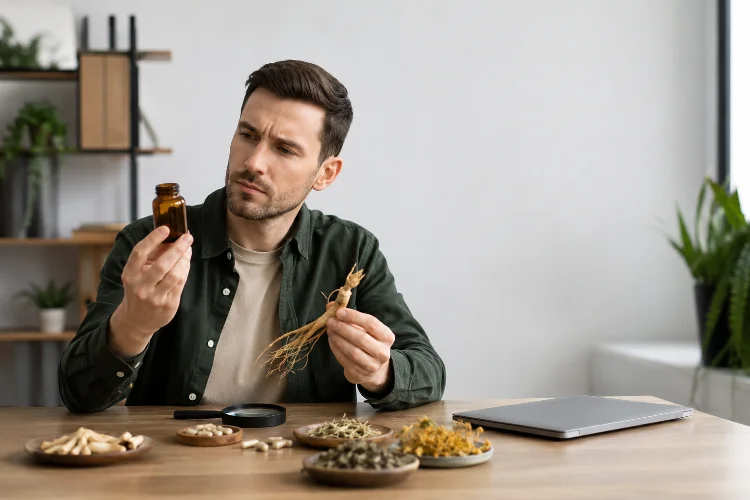
Herbal health claims are everywhere. One video says a certain root “balances hormones,” another website calls an herb a “natural detox,” and a product advertisement promises better sleep, immunity, digestion, energy, and mood-all from the same bottle.
Some herbal products do have useful scientific evidence behind them. Others have only preliminary research, traditional use, laboratory findings, or marketing language supporting their claims. The difficult part for beginners is learning how to tell the difference.
Knowing how to evaluate herbal claims with evidence and caution does not mean dismissing traditional herbal knowledge. It means asking better questions before accepting a health claim as fact.
The NIH Office of Dietary Supplements notes that the amount and quality of scientific evidence available for supplements varies widely. NCCIH also warns that commercially available supplements can differ from the products actually tested in research studies.
With a few practical habits, you can become much better at separating promising evidence from exaggerated marketing.
Start by Asking Exactly What the Herbal Claim Says
Before checking whether a claim is true, define what is actually being claimed.
Statements such as “supports relaxation,” “helps maintain digestive health,” and “cures anxiety” may sound similar in casual conversation, but they represent very different levels of certainty.
In the United States, the FDA distinguishes between several types of claims used for foods and dietary supplements.
A structure/function claim may describe how an ingredient supports the normal structure or function of the body, while supplements generally cannot legally claim to diagnose, treat, cure, or prevent a disease unless the relevant regulatory requirements for such a claim are met.
That means words such as supports, maintains, and promotes deserve careful interpretation.
They do not automatically mean that clinical trials have shown the product can treat a medical condition.
Look at What Kind of Evidence Supports the Claim
Not all scientific evidence carries the same weight.
A laboratory experiment may show that an herbal compound affects cells in a dish. An animal study may reveal an interesting biological effect.
These studies can be valuable for understanding possible mechanisms, but they cannot automatically tell us whether the same result will occur safely in humans.
Human clinical studies generally provide more directly relevent information.
Even then, one small trial is rarely the final answer. Researchers may need multiple well-designed studies before they can become confident that an effect is real, meaningful, and reproducible.
This is why the question should not simply be, “Is there a study?”
A better question is:
What type of study was conducted, how strong was it, and do other studies reach similar conclusions?
The World Health Organization emphasizes that traditional medicine should be evaluated through rigorous scientific approaches to establish safety and effectiveness, even when a practice has a long history of use.
Learn to Read Clinical Studies More Carefully
You do not need a medical degree to notice some basic strengths and weaknesses in herbal research.
Start with the number of participants. A trial involving 20 people may provide an interesting signal, but its results are generally less convincing than several larger, well-designed studies showing similar outcomes.
Next, look for a comparison group.
Why Placebo-Controlled Trials Matter
Imagine 100 people take an herbal sleep supplement and 60 report sleeping better.
That sounds impressive until you learn that 55 out of 100 people receiving a placebo also improved.
A controlled study helps researchers determine whether the herbal preparation performed better than improvement caused by expectations, natural symptom changes, lifestyle factors, or other influences.
Randomization and blinding can strengthen a trial further by reducing certain forms of bias.
You should also examine what researchers actually measured. “Participants felt slightly calmer on a questionnaire” is different from “the treatment was proven to cure an anxiety disorder.”
Small wording differences can completely change the meaning of a study.
Check Whether the Product Matches the Research
This is one of the most commonly overlooked issues in herbal medicine.
Suppose a clinical trial studies a specific standardized extract containing a defined concentration of certain plant constituents. You then purchase a generic powder made from the same species.
Are they equivalent?
Not necessarily.
NCCIH specifically cautions that supplements available in stores or online may differ in important ways from products used in scientific studies.
The plant species, plant part, extraction method, concentration, dosage, manufacturing process, and chemical composition can all matter.
An herbal tea, dried powder, tincture, concentrated extract, and standardized capsule should not automatically be treated as interchangeable simply because the same plant name appears on the label.
Whenever you read positive research, check what preparation researchers actually used.
That small step can prevent a lot of misleading comparision.
Separate Traditional Use From Clinical Evidence
Traditional knowledge is valuable, but it answers a different question from a modern clinical trial.
If an herb has been used for hundreds of years, that tells us something important about its historical and cultural role. It may also give researchers useful ideas about which plants deserve further investigation.
However, long-term traditional use does not automatically prove effectiveness for a specific medical condition.
WHO recognizes the importance of traditional medicine while also emphasizing the need for scientific validation of safety and efficacy.
A useful way to read herbal information is to notice the language being used.
“This herb has traditionally been used for…” is a historical statement.
“Researchers have demonstrated that this herb effectively treats…” is a scientific claim that requires much stronger evidence.
Both can appear in responsible herbal education, but they should never be quietly substituted for each other.
Watch for Common Herbal Marketing Red Flags
Some claims should immediately make you more skeptical.
Be cautious when a product supposedly treats an enormous range of unrelated conditions. Claims that one supplement can simultaneously fix immunity, hormones, digestion, memory, blood sugar, chronic pain, weight, and sleep are worth examining especially carefully.
Words such as “miracle,” “secret cure,” “doctors don’t want you to know,” and “works for everyone” are also warning signs.
Another red flag is relying entirely on testimonials.
Personal stories can be emotionally convincing, but they cannot establish cause and effect. Someone may improve because of other treatment, lifestyle changes, placebo effects, natural recovery, or factors they never mention.
Also watch for claims based entirely on statements such as “scientifically proven” without links to actual studies.
Good evidence should be traceable.
If a company cites research, look for the original study rather than relying exclusively on the company’s interpretation of it.
Do Not Confuse “Natural” With “Safe”
Perhaps the most persistent misconception surrounding herbal products is that natural substances are automatically gentle.
Plants contain biologically active chemicals. That is partly why herbal medicine is interesting in the first place-and also why certain products can cause side effects or interact with medicines.
NCCIH reports that herbal supplements may interact with medications and may create additional risks for people with certain health conditions or those preparing for surgery.
St. John’s wort is a useful example. It can interact with numerous medicines and affect how some drugs are processed in the body.
Pregnancy, breastfeeding, childhood, liver or kidney disease, surgery, and prescription medication use can make safety questions especially important.
The safest question is therefore not simply, “Is this herb natural?”
Ask, “What are its known risks, interactions, contraindications, and uncertainties?”
Consider Product Quality as Part of the Evidence
Even strong research on an herb does not guarantee that every supplement containing its name has the same quality.
Botanical products can vary in identity, concentration, purity, and formulation. NIH resources therefore encourage consumers to consider both the scientific evidence and the quality of the actual supplement being used.
In the United States, dietary supplements are not generally required to undergo the same premarket testing for safety and effectiveness as pharmaceutical drugs.
This makes careful purchasing important.
Look for transparent labeling that clearly identifies the plant, amount, serving size, manufacturer, and other ingredients.
Independent quality certification can provide additional information about manufacturing quality, although quality testing does not automatically prove that a product is clinically effective.
Purity and efficacy are two seperate questions.
A perfectly manufactured supplement can still have little evidence for the health claim being advertised.
Use Reliable Sources Instead of Social Media Alone
Online health information varies enormously in quality.
A good starting point is an independent source that summarizes both potential benefits and known uncertainties.
The NIH Office of Dietary Supplements provides evidence-based fact sheets covering health effects, safety, medication interactions, and other issues for supplements and botanical ingredients.
NCCIH also maintains information about individual herbs, research findings, supplement safety, and herb-drug interactions.
When evaluating a website, ask who wrote the information, what qualifications they have, whether references are provided, when the page was updated, and whether the same organization is selling the product.
Financial interests do not automatically make information false, but they are worth noticing.
The goal is to build a habit of verificaton rather than accepting the first confident answer you encounter.
A Simple Five-Question Evidence Check
You can make herbal evaluation surprisingly straightforward.
Whenever you encounter a new claim, ask:
- What exactly is being claimed?
- What type of evidence supports it?
- Was the actual herbal preparation tested in humans?
- What risks, interactions, and uncertainties are known?
- Is the source independent, transparent, and scientifically credible?
If you cannot answer those questions, that does not necessarily mean the herb is useless.
It simply means your confidence in the claim should remain limited until better information becomes available.
Scientific caution is not the same as saying “no.” Sometimes the most accurate answer is simply we do not know yet.
Evaluating herbal claims is less about deciding whether herbal medicine is “good” or “bad” and more about learning to judge individual claims fairly.
Start by defining what the product actually promises. Then examine the type and quality of evidence, check whether the tested preparation matches the product being discussed, separate traditional use from clinical proof, and investigate safety and medication interactions.
Be especially cautious when you see miracle language, testimonials presented as proof, or claims that one herb treats many unrelated diseases.
Next time you encounter an exciting herbal claim online, resist the urge to immediately believe or dismiss it. Open a reliable evidence source, investigate the original claim, and see what the research actually supports.
That simple habit can make you a much smarter-and safer-herbal learner.