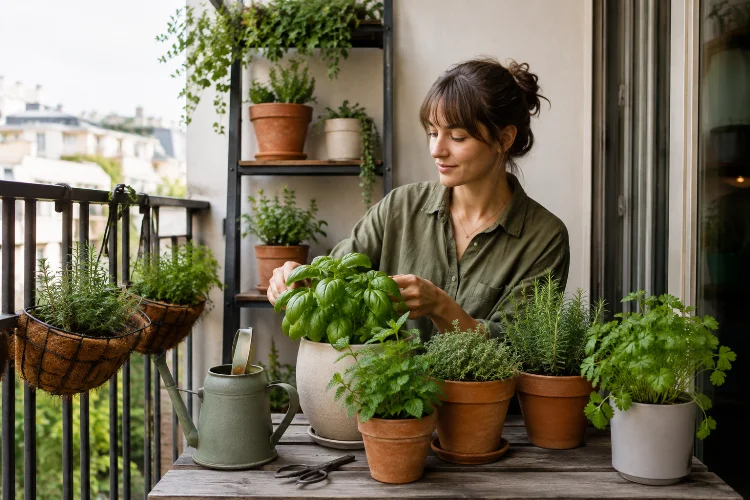
You do not need a large backyard, raised beds, or a greenhouse to grow useful herbs. A sunny balcony, apartment patio, windowsill, doorstep, or even a small corner near your kitchen can provide enough room for a surprisingly productive collection of plants.
Learning how to start a small herbal garden in limited space is mostly about making smart choices. The right containers, good drainage, suitable herbs, enough light, and thoughtful watering matter far more than the total size of your garden.
Container gardening is particularly useful because most herbs can grow successfully in pots, provided their basic needs are met. Illinois Extension recommends containers with drainage holes and a loose, well-drained potting mix for herbs.
For beginners, starting small has another advantage: fewer plants mean you can actually learn how each one grows.
Instead of buying 20 herbs immediately, begin with three or four plants you genuinely expect to use. Your tiny garden can expand as your confidence grows.
Start With the Space You Already Have
Before buying seeds or pots, examine your available growing space.
Watch the area at different times of day. Does it receive direct morning sunlight? Strong afternoon sun? Mostly indirect light? Is it protected from heavy rain and wind?
Light is especially important. Many common herbs grow best with generous sunlight, and Illinois Extension notes that many perennial herbs perform best with roughly six to eight hours of sun each day, although some herbs tolerate partial shade.
If you live in an apartment, possibilities include a balcony railing, sunny window, wall-mounted planter, small outdoor shelf, or narrow collection of pots beside a door.
Indoor herb growing is possible too, but light often becomes the limiting factor. Illinois Extension notes that indoor herb gardens generally require a bright window or supplemental lighting for good results.
Start with your light conditions rather than forcing a particular herb into an unsuitable location.
Choose Herbs That Make Sense for a Small Garden
A limited garden works best when every plant earns its space.
Think about what you actually cook with or want to learn about. Basil may be valuable if you regularly prepare pasta or salads. Mint is useful for drinks and teas. Thyme, rosemary, oregano, parsley, and chives are other popular choices.
Smaller or relatively slow-growing plants are especially convenient for containers. Illinois Extension specifically recommends choosing compact and slower-growing herbs when gardening in pots.
Good Herbs for Beginners
Basil is productive during warm weather and responds well to regular harvesting. Chives can grow successfully in containers and can even be kept indoors in a bright location.
Thyme and rosemary are good options for sunny locations with well-draining soil.
Mint is extremely easy to grow, but it deserves its own container because of its enthusiastic spreading habit. Penn State specifically recommends growing invasive perennial herbs such as mint and lemon balm in pots.
If space is truly tiny, start with three herbs you use frequently rather than creating a miniature botanical collection that becomes difficult to maintain.
Pick Containers With Good Drainage
Almost any container can potentially become an herb planter, but drainage is non-negotiable.
University of Minnesota Extension recommends that containers used for herbs, whether indoors or outdoors, have holes in the bottom so excess water can escape.
Without drainage, water collects around the roots. That creates poor growing conditions and can contribute to root problems.
Container size matters too.
A tiny decorative pot may look attractive on Instagram, but a rapidly growing basil plant can quickly become cramped. Illinois Extension recommends choosing a container large enough for the mature herb rather than expecting it to remain comfortable in a very small nursery pot.
You can use terracotta pots, plastic containers, window boxes, hanging pots, or larger mixed planters. Penn State notes that window boxes and strawberry-style pots can be particularly useful for small herb gardens.
The best container is ultimately one that fits your space, provides enough root room, and drains properly.
Use Potting Mix Instead of Heavy Garden Soil
Filling a container with soil dug directly from the ground may seem like the cheapest option, but it is usually not ideal.
Container plants need a growing medium that holds some moisture while still allowing air and excess water to move through it. Illinois Extension recommends a loose, well-drained potting mix for container-grown herbs.
A commercial potting mix is an easy starting point for beginners.
Do not pack it down too tightly. Roots need access to both moisture and oxygen, and heavily compacted material makes good drainage more difficult.
Mediterranean herbs such as rosemary, thyme, sage, and oregano generally appreciate especially good drainage. RHS even recommends these types of herbs for container combinations, with containers that provide plenty of drainage holes.
Good soil structure makes everyday maintanance much easier.
Group Herbs With Similar Needs
One large planter can save space, but combining random herbs is not always a good idea.
Plants sharing a container also share water, soil, nutrients, and root space. Ideally, they should have reasonably similar growing requirements.
For example, rosemary, thyme, sage, oregano, and marjoram are commonly grouped as Mediterranean-style herbs. RHS recommends combinations involving herbs such as sage, thyme, rosemary, marjoram, and oregano for container growing.
Mint is usually better alone because it spreads aggressively.
Basil may prefer more consistent moisture than drought-tolerant Mediterranean herbs, so giving it a separate pot can make watering easier.
Also consider mature size. A tall rosemary plant can eventually overshadow tiny thyme if the container becomes crowded.
Small-space gardening is not about squeezing the maximum number of plants into every centimeter. It is about using the available area efficiently while giving each plant enough room to stay healthy.
Learn When Your Herbs Actually Need Water
Watering is where many first-time container gardeners struggle.
A common mistake is watering according to a fixed calendar: perhaps every morning or every two days. Plants do not use water according to your calendar, however.
Temperature, sunlight, wind, container size, plant size, and growing medium all influence how quickly a pot dries.
Check the soil instead.
Feel the upper layer with your finger. If it is still noticeably moist, the plant may not need more water yet. When watering, apply enough moisture to reach the root zone and allow excess water to escape through the drainage holes.
University of Minnesota Extension notes that plants receiving less light tend to grow more slowly and consume less water, increasing the importance of avoiding unnecessary watering indoors.
At the opposite extreme, containers exposed to hot sun and wind can dry surprisingly quickly.
Observation is much better than rigid scheduling.
Make the Most of Vertical Space
When floor area disappears, start thinking upward.
A narrow shelving unit can hold several pots while occupying roughly the same floor space as one large container. Wall planters, hanging baskets, railing planters, and tiered stands can also turn unused vertical surfaces into productive growing areas.
Just remember that upper plants may shade those beneath them.
Place sun-loving herbs where they receive the strongest light, while slightly more shade-tolerant plants can occupy less exposed positions.
Accessibility matters as well. Herbs are much more likely to be harvested when they are easy to reach. RHS recommends keeping containers near the house where herbs can be picked conveniently.
A compact herb garden positioned beside the kitchen can therefore be more useful than a much larger garden hidden at the far end of a property.
Design around how you actually live.
Harvest Regularly to Keep the Garden Productive
Growing herbs is only half the experience. Harvesting them properly keeps your garden useful and can encourage many herbs to produce additional growth.
Rather than allowing basil, mint, or other leafy herbs to become tall and neglected, collect modest amounts regularly.
Use clean scissors or pinch tender growth where appropriate. Avoid removing most of a small plant at once, especially when it is still becoming established.
With woody herbs such as rosemary and thyme, harvest manageable portions rather than cutting deeply into old woody sections without understanding the plant’s growth habit.
Regular harvesting also gives you an opportunity to inspect your plants.
Look underneath leaves for pests, notice unusual discoloration, check whether stems are becoming crowded, and remove dead material. Catching a small problem early is usually much easier than rescuing a badly stressed plant later.
You will gradually learn each herb’s rhythm simply by observing it.
Avoid Trying to Grow Too Much at Once
The most attractive small herb gardens are not necessarily the ones with the largest number of species.
A beginner with basil, mint, rosemary, thyme, and chives can learn an enormous amount about different growth habits, moisture preferences, aromas, harvesting methods, and seasonal changes.
Adding too many plants immediately can make problems harder to diagnose.
If several herbs begin wilting, you may not know whether you are overwatering, underwatering, providing insufficient sunlight, or simply using containers that are too small.
Start with a manageable collection.
After a few weeks, you will understand wich locations dry fastest, where sunlight is strongest, and which herbs seem happiest in your particular enviroment.
That local knowledge is more useful than blindly following a universal gardening schedule.
Starting a small herbal garden does not require much space. A few well-chosen pots in a sunny window, balcony, patio, or doorway can provide fresh basil, mint, rosemary, thyme, chives, and other useful herbs throughout the growing season.
The key is matching plants to your conditions. Check your available sunlight, use containers with drainage holes, choose a quality potting mix, group herbs with compatible needs, and water according to the soil rather than a rigid schedule.
Most importantly, begin small. Choose three herbs you genuinely use and learn how each one grows before expanding your collection.
Find your sunniest practical corner today, place your first few containers there, and turn that overlooked space into a simple herbal garden you can actually enjoy.