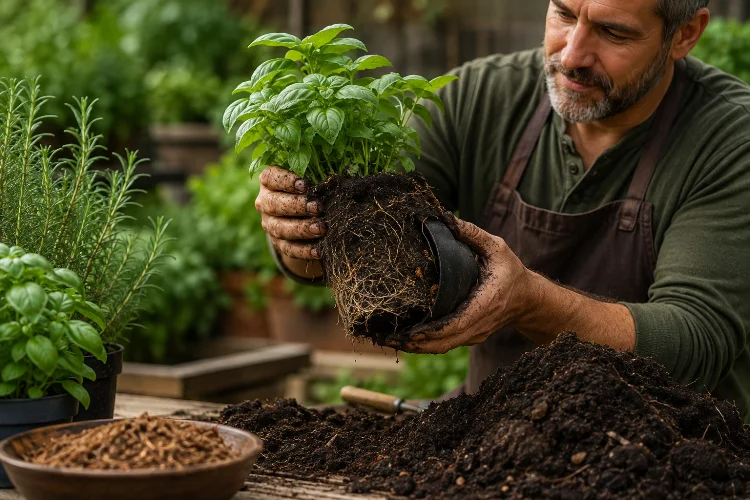
When people start growing herbs, they usually focus on what happens above the ground. They watch for new basil leaves, trim rosemary stems, check whether mint is spreading, and wait for parsley to become large enough to harvest.
But much of a herb’s success is decided where you cannot see it: in the soil.
Understanding how healthy soil supports stronger and safer herb growth can make gardening easier and more productive. Good soil gives roots access to water, oxygen, nutrients, and space while supporting biological processes that help plants grow.
USDA’s Natural Resources Conservation Service notes that healthy soils can improve nutrient cycling, root development, and water absorption.
Soil quality also matters when herbs are intended for food or tea. Contaminants, poorly handled manure, excessive fertilizer, and unsuitable growing conditions can introduce unnecessary risks.
You do not need perfect soil. You simply need to understand what healthy herb-growing soil looks like and how to improve it gradually.
Healthy Soil Gives Herb Roots Room to Grow
A healthy herb begins with a healthy root system.
Roots need more than moisture. They also require oxygen and physical space to spread through the soil.
When soil becomes severely compacted, pore spaces are reduced, which can limit aeration and make it harder for water and roots to move normally through the ground. USDA soil guidance notes that compaction increases soil density while decreasing pore space.
This is one reason loose, well-structured soil feels so different from hard, compacted ground.
For an herb such as basil, parsley, or chives, a healthy root zone allows the plant to establish itself efficiently. Stronger roots can explore a larger area for moisture and nutrients, helping support steady growth above ground.
Try not to repeatedly walk over herb beds. In containers, use an appropriate potting mix rather than packing heavy garden soil tightly into a pot.
Small improvements underground can make a suprisingly visible difference above it.
Good Drainage Helps Prevent Waterlogged Roots
Herbs need water, but more water does not always mean healthier plants.
Most commonly grown herbs prefer soil that drains properly. University of Minnesota Extension recommends well-drained soil for the majority of herbs and lists a general preferred pH range of about 6.0 to 7.5.
Waterlogged soil fills air spaces with water for long periods. Roots can then struggle under low-oxygen conditions, and overly wet conditions may encourage certain root diseases.
Mediterranean herbs such as rosemary, thyme, oregano, and sage are particularly associated with well-drained growing conditions. Penn State Extension likewise emphasizes good drainage as an important feature of herb-growing soil.
If your garden has heavy clay soil that stays wet after rain, consider improving its structure with appropriate organic matter or growing herbs in raised beds.
For containers, drainage holes are essential. A beautiful decorative pot without anywhere for water to escape can quickly become a poor environment for roots.
Organic Matter Improves More Than Fertility
Gardeners often think of compost simply as plant food, but organic matter has a much broader role in soil health.
USDA reports that soil organic matter contributes to water infiltration, soil structure, aggregate stability, nutrient retention, and other important soil functions.
Organic matter can help sandy soil hold moisture more effectively while improving the structure and workability of heavier soils.
It also provides material that supports soil organisms.
However, more compost is not automatically better. University of Minnesota Extension cautions that excessive compost applications can contribute to high phosphorus or soluble salt levels, while a modest amount can improve aeration and provide useful organic matter.
That is especially important with herbs because many species do not require extremely rich soil.
Healthy soil is about balance—not continuously adding fertilizer and compost until the bed becomes overloaded.
Soil Organisms Are Part of the Growing System
A handful of living soil contains much more than mineral particles.
Soil supports bacteria, fungi, microscopic organisms, insects, worms, and other forms of life. Collectively, these organisms participate in decomposition and nutrient cycling.
USDA explains that soil organisms consume organic materials and interact within soil food webs, helping release nutrients that can become available to plants.
That does not mean gardeners need to buy expensive products claiming to contain magical microbes.
A more practical approach is to create conditions that support normal soil biology: maintain organic matter, avoid unnecessary disturbance, keep living roots present when practical, and protect exposed soil.
The goal is not to make soil “alive” through one special product. Healthy garden soil is already a complex biological environment.
Thinking about soil as an ecosystem rather than just dirt is one of the biggest mindset changes a beginner gardener can make.
The Right Soil pH Helps Herbs Access Nutrients
Fertilizer will not solve every nutrient problem.
Soil pH influences chemical processes that affect how available certain nutrients are to plants. This means soil may contain nutrients while conditions still make some of them harder for roots to obtain efficiently.
For many common herbs, a slightly acidic to near-neutral range works well.
University of Minnesota Extension gives approximately 6.0 to 7.5 as a useful general range for most herbs, although individual species have their own preferences. Parsley, for example, is generally recommended for well-drained soil around pH 6.0 to 7.0.
Instead of guessing, consider a soil test.
A proper test can reveal pH and nutrient information, helping you decide whether lime, fertilizer, compost, or another amendment is actually needed. Penn State also recommends testing garden soil before making corrections.
Adding amendments without testing can sometimes create a new problem while trying to fix another.
Too Much Fertilizer Can Be Counterproductive
It is easy to assume that lush growth always means a better herb.
That is not necessarily true.
University of Minnesota Extension warns that excessively nutrient-rich conditions can encourage rapid, lush herb growth with lower concentrations of the essential oils responsible for characteristic aromas and flavors.
Chives are another example where over-fertilizing can be counterproductive; slower, compact growth may produce healthier plants and stronger flavor.
The practical lesson is simple: feed the soil according to need rather than habit.
If plants are already growing well, adding another handful of fertilizer simply because the package promises “bigger growth” may not help.
Follow fertilizer labels carefully and base larger soil corrections on a soil test whenever possible.
Healthy fertility means supplying what plants need-not trying to force maximum growth at all times.
Clean Soil Matters When You Plan to Eat the Herbs
When growing ornamental flowers, soil contamination is concerning. When growing something you plan to put into pesto, tea, soup, or salad, it deserves even more attention.
Urban and older residential soils can sometimes contain lead or other contaminants related to previous land uses, paint, industry, traffic, or imported fill.
The U.S. Environmental Protection Agency recommends testing soil used to grow food when lead contamination may be a concern. In areas with higher lead levels, EPA suggests options such as using raised beds or containers filled with clean soil.
This is especially relevant if you do not know the history of a property.
Do not assume that dark, rich-looking soil is automatically clean. Contaminants are not necessarily visible or detectable by smell.
If you are growing herbs on an old urban property, former industrial land, or another questionable site, testing can provide far more useful information than appearance alone.
Be Careful With Manure and Homemade Compost
Organic does not automatically mean harmless.
Fresh or improperly composted manure can contain microorganisms of concern. University of Minnesota Extension notes that manure may contain human pathogens such as E. coli or Salmonella if it has not been properly composted.
FDA produce-safety guidance also treats untreated animal manure as a potential source of microbial contamination and distinguishes it from properly treated, stabilized compost.
This matters particularly for herbs because leaves may be eaten fresh with little or no cooking.
Use compost from a trustworthy source, and learn proper composting methods before applying homemade animal-manure compost around edible plants.
Penn State’s home-garden food-safety guidance similarly recommends reputable compost sources and established composting procedures.
Always wash harvested herbs before using them.
Healthy soil supports safer growing conditions, but basic food hygiene is still neccessary.
Build Better Soil Gradually
You do not need to replace an entire garden bed because your soil is less than ideal.
Start by observing it.
Does water disappear quickly or remain in puddles for hours? Is the ground hard and compacted? Do plants show weak growth? Has the soil ever been tested?
Next, add amendments only when they solve a genuine problem.
Moderate additions of mature compost can contribute organic matter, while mulch can help reduce water loss and protect the soil surface. Mulch can also reduce soil splashing onto foliage during watering or rain.
For container herbs, start with a commercial potting mix designed to provide good drainage rather than ordinary yard soil.
Over time, pay attention to root development, water movement, plant color, aroma, and overall vigor.
Soil improvement is usually a process rather than a one-time project.
Healthy soil is the foundation of a productive herb garden.
It gives roots room to develop, manages water more effectively, supports nutrient cycling, provides habitat for soil organisms, and creates better conditions for herbs such as basil, parsley, thyme, rosemary, sage, and chives.
Good soil management also has a safety dimension. Unknown contamination, improperly composted manure, excessive fertilizer, and poor drainage can all create avoidable problems.
Start by examining the soil you already have. Check drainage, consider a soil test, add organic matter only when appropriate, and use clean growing media when contamination is a concern.
Before buying another fertilizer or new herb plant, spend some time improving what is underneath them. Better soil is one of the simplest investments you can make in a stronger, healthier herb gardan.