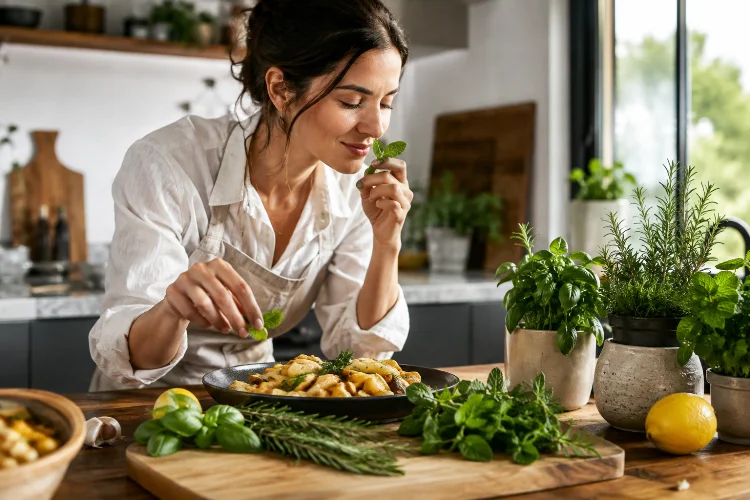
A few basil leaves can completely change a bowl of pasta. Rosemary can turn simple roasted potatoes into something deeply aromatic, while fresh mint can make a glass of water smell surprisingly refreshing.
Culinary herbs are powerful because we often use them in small quantities, yet their influence on food can be enormous. USDA describes culinary herbs as plants widely used as both food and flavouring, capable of adding colour, character, and interest to dishes.
But herbs can teach us much more than cooking.
Learning how culinary herbs add flavour, aroma, and plant knowledge creates an easy bridge between the kitchen and basic botany.
When you grow, smell, touch, and harvest basil, thyme, rosemary, mint, parsley, or dill, you naturally begin noticing botanical families, leaf arrangements, flowers, stems, growth habits, and seasonal changes.
Instead of memorizing plant terms from a textbook, you start recognizing them in herbs you already know.
That makes the kitchen herb garden one of the simplest places to begin understanding plants.
What Makes Culinary Herbs So Flavourful?
When we describe basil as sweet and peppery or rosemary as pine-like, we are responding to a complicated mixture of chemical compounds.
Flavour itself involves both taste and aroma. USDA’s National Agricultural Library explains that flavour includes these two closely connected sensory experiences, while basic taste includes sweetness, sourness, saltiness, bitterness, and umami.
Herbs contribute heavily through aroma.
Their leaves contain volatile compounds that can reach receptors in the nose while we smell the plant or eat a dish. This is why crushing a mint leaf between your fingers suddenly releases a much stronger fragrance.
Basil provides a good example. USDA research describes sweet basil as an important culinary herb used to provide distinct aroma and flavour, and studies have identified numerous aroma-related compounds in the plant.
This chemistry is also why two herbs that look similar can taste dramatically different.
Our experience of an herb is partly botanical and partly chemical.
Aroma Is a Fast Way to Start Recognizing Plants
Beginning plant identification can feel intimidating because botany comes with lots of unfamiliar vocabulary.
Culinary herbs make the process much easier because many have distinctive fragrances.
Spearmint leaves, for example, have a strong recognizable fragrance and flavour. NC State Extension notes that they are widely used in teas, beverages, salads, sauces, and other culinary preparations.
Rosemary offers another very different sensory experience. It is an aromatic evergreen shrub with narrow, needle-like leaves and fragrant foliage commonly used in cooking.
Smelling these plants repeatedly helps connect an aroma with visual features.
Eventually, you stop thinking only, “This smells like rosemary.”
You begin noticing, “Rosemary has narrow opposite leaves, woody stems, and a shrub-like form.”
That shift from recognizing flavour to recognizing plant structure is the beginning of practical botannical knowledge.
Culinary Herbs Introduce You to Plant Families
Once you begin comparing herbs, something interesting happens: you discover that very different flavours can come from closely related plants.
Basil, mint, rosemary, thyme, oregano, and sage all belong to the Lamiaceae, commonly called the mint family. University of Minnesota Extension notes that many common culinary herbs belong either to the mint family or the carrot family.
Members of the mint family often share structural characteristics.
Many have opposite leaves, aromatic foliage, and stems that may appear square in cross-section. Their flowers can also share recognizable patterns.
Yet their flavours are completely different.
Sweet basil does not taste like thyme, and thyme does not smell like spearmint. Their shared family relationship gives them similarities in structure without making them identical.
The same idea appears in the carrot family, which includes culinary plants such as parsley and dill.
Learning families makes plant identification more systematic. Instead of memorizing every herb as an isolated species, you begin recognizing groups of related plants.
That is a major step toward understanding botany.
Leaves Teach You More Than You Might Expect
Spend a few minutes comparing culinary-herb leaves and you already have a simple lesson in plant morphology.
Rosemary has narrow, needle-like leaves. Spearmint has broader leaves with toothed margins. Basil typically has wider, softer foliage, while common thyme produces very small aromatic leaves on compact stems.
NC State describes common thyme as a small aromatic culinary plant usually forming a mound only about 6-12 inches high.
These differences introduce basic identification features such as shape, margin, texture, colour, and arrangement.
You may notice that some leaves grow opposite each other while others alternate along the stem.
You can also compare surface texture.
Sage may feel soft or slightly fuzzy, basil relatively smooth, and rosemary firm and leathery.
None of this requires complicated equipment. Simply looking closely at herbs before chopping them can train your observation skills.
The next time you cook with three herbs, put them beside each other first. Compare their leaves before tasting them.
That simple habit gradually turns cooking into plant study.
Growth Habits Help Explain How Herbs Behave
Culinary plants do not all grow in the same way.
Basil is commonly grown as a leafy annual in many climates, while rosemary can become a woody perennial shrub. Thyme often stays low and compact, while mint spreads aggressively through underground rhizomes.
NC State specifically notes that spearmint can spread rapidly and is often best grown in a container when gardeners want to control it.
This difference teaches another basic botanical concept: growth habit.
Some herbs stand upright. Others creep along the ground, branch into shrubs, form clumps, or spread underground.
Watching these habits also makes gardening easier.
Once you understand how mint grows, you know why planting it beside slower herbs may become problematic. When you recognize rosemary as a woody perennial, you understand why it behaves differently from soft annual basil.
Plant knowledge therefore becomes practical rather than purely academic.
It helps you decide where herbs should grow and how they should be maintained.
Flowers Reveal Another Side of Familiar Herbs
Many people recognize herbs only by their leaves because they harvest them regularly before flowering.
Let a few plants bloom, however, and they begin revealing important identification features.
Dill produces umbrella-like flower clusters and later forms seeds. University of Minnesota Extension recommends harvesting dill foliage before those flower clusters fully open if leaves are the goal, while seed harvest occurs later when seeds begin ripening.
Spearmint produces small flowers in terminal spikes that can be lilac, pink, or white. Rosemary produces small two-lipped flowers, commonly blue, lavender, or white.
Flowers can therefore help confirm plant identity.
They also show that herbs are not just ingredients manufactured for kitchens. They are complete flowering plants with reproductive cycles and ecological relationships.
Allowing some culinary herbs to bloom can attract insects and gives students a chance to observe flower shape, pollination, and eventually seed development.
Suddenly, the herb garden becomes a miniature botany classroom.
Harvest Timing Changes Flavour and Aroma
Plant knowledge can even improve your cooking.
The chemical composition of herbs changes as plants develop. Harvesting at different stages may influence the aroma and flavour you experience.
Common thyme is a good example. NC State recommends harvesting it shortly before flowering, when the essential-oil content of its leaves is considered near its peak.
University of Minnesota Extension similarly advises gardeners to harvest culinary herbs throughout the growing season by clipping sprigs and leaves as needed.
This introduces a valuable lesson: a plant is never chemically or physically static.
Young leaves can differ from old leaves. A flowering plant may smell or taste different from one focused on leafy growth.
Environmental conditions also matter. USDA research on basil has found that growing conditions can influence leaf characteristics and concentrations of aroma compounds.
So flavour is not only about species.
It is also connected to growth stage, environment, harvesting, and handling.
Fresh and Dried Herbs Behave Differently
Fresh basil and dried basil clearly come from the same plant, yet they do not create exactly the same sensory experience.
Drying removes water and changes the concentration and stability of aromatic compounds. Some herbs preserve their character remarkably well, while others lose much of the fresh aroma people value.
Woody herbs such as rosemary and thyme are especially familiar in dried form.
Tender basil is often prized fresh because its bright aromatic character changes noticeably after drying.
Learning this difference encourages experimentation.
Cook the same simple dish twice-once with fresh thyme and once with dried thyme. Notice how aroma intensity and texture differ.
You can do the same with mint, parsley, oregano, or basil.
These comparisons teach a practical principle of plant chemistry: processing changes plant material.
Drying, crushing, heating, and storing herbs all affect what eventually reaches your nose and tongue.
That is plant science hiding inside everyday cooking.
Growing Herbs Makes Plant Knowledge Easier to Remember
You can learn botanical facts from a book, but growing an herb makes them much harder to forget.
If you raise basil from seed, you see germination, seedling leaves, mature foliage, branching, flowering, and eventually seed production. Growing parsley reveals a diffrent shape and life cycle, while rosemary introduces woody perennial growth.
University of Minnesota Extension describes basil as one of the easiest and most popular culinary herbs to grow, making it an accessible starting plant for beginners. Parsley can also be grown in containers and even indoors when provided with suitable light and drainage.
Growing several species side by side makes comparison especially useful.
You can examine how quickly each grows, how much water it needs, when it flowers, how its aroma develops, and what happens after harvesting.
That repeated contact builds familiarity.
Instead of remembering a plant because you memorized its photograph, you remember it because you watered it, smelled it, cooked with it, and watched it change.
Culinary Herbs Connect Botany With Everyday Life
Perhaps the biggest advantage of culinary herbs is accessibility.
You do not need to travel into a forest or study rare species to begin learning about plants.
A supermarket bunch of parsley can teach you about leaf structure. A pot of mint can demonstrate rhizomatous spreading. Rosemary introduces evergreen woody growth, while flowering dill provides an easy example of umbels and seed development.
Herbs also encourage multisensory learning.
You can look at them, touch them, smell them, taste appropriate culinary species, grow them, harvest them, and compare them through the seasons.
This creates stronger associations than simply looking at diagrams.
Of course, familiarity in the kitchen does not mean every wild relative is safe to eat. Identification should still be cautious, especially when moving from cultivated herbs to wild plants.
But culinary herbs provide a safe and familiar place to build the observation skills needed for more advanced plant learning.
Culinary herbs do much more than make food taste better.
Their volatile compounds create distinctive aromas, their leaves and stems introduce basic plant morphology, and their flowers, growth habits, and seasonal changes provide practical lessons in botany.
Basil, mint, rosemary, thyme, parsley, and dill can transform an ordinary kitchen or garden into a simple plant-learning space.
The best way to begin is not by memorizing dozens of botanical terms. Choose three familiar herbs and study them carefully. Compare their leaves, smell them before and after crushing, observe how they grow, and notice when they flower.
Then use them in a meal.
When flavour, aroma, gardening, and observation come together, plant knowledge becomes something you experience rather than something you simply memorize.