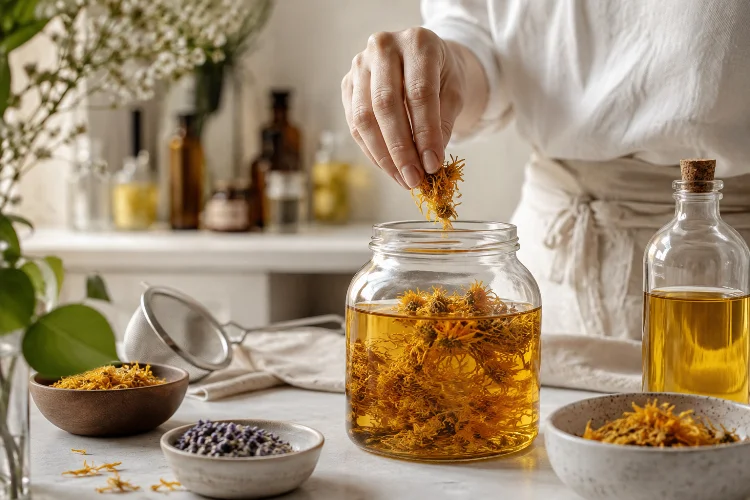
A jar filled with golden oil and dried calendula flowers may look simple, but there is quite a bit of plant chemistry happening inside it.
Oil can act as an extraction medium, drawing certain compounds from herbal material and creating what is commonly called an herbal infused oil.
Learning how herbal oils are prepared for external educational use is a useful introduction to herbal extraction. It demonstrates how the choice of plant, carrier oil, moisture level, temperature, time, and storage conditions can influence the finished preparation.
It is also important to understand what these products are not. An herbal infused oil is different from an essential oil, which is a much more concentrated aromatic product usually obtained through processes such as distillation.
NCCIH describes essential oils as concentrated plant substances commonly used through inhalation or in diluted form on the skin.
For beginners, herbal oil preparation is best treated as an exercise in understanding extraction and formulation rather than as a method for treating medical conditions.
What Is an Herbal Infused Oil?
An herbal infused oil is generally made by placing suitable plant material in a fixed or carrier oil so that oil-soluble constituents can move from the herb into the surrounding liquid.
Examples of carrier oils include olive, sunflower, jojoba, and other oils used in cosmetic or topical preparations. The exact oil selected can influence texture, stability, aroma, and the overall feel of the finished product.
Oil extraction is not merely a modern DIY idea. The European Medicines Agency describes calendula oil, for example, as a preparation traditionally produced by extracting calendula flowers with olive or peanut oil at a specified ratio.
WHO guidance also recognizes that herbal preparations can be produced with edible oils and that extraction conditions should be defined rather than improvised randomly.
The basic principle is similar to making a tincture or infusion: a solvent comes into contact with plant material and dissolves substances compatible with that solvent.
In this case, the solvent happens to be oil.
Herbal Infused Oils Are Not Essential Oils
This distinction causes a lot of confusion.
An infused calendula oil might contain calendula flowers soaked in olive oil. The finished product remains mostly carrier oil containing compounds extracted from the plant.
An essential oil is very different. Essential oils are highly concentrated mixtures of volatile aromatic plant substances and are frequently obtained through distillation or related techniques.
NCCIH notes that essential oils used in aromatherapy are commonly inhaled or applied to the skin in diluted preparations.
They should therefore not be substituted drop-for-drop for infused herbal oils.
Peppermint demonstrates why the difference matters. NCCIH reports that topical peppermint oil can cause skin irritation or rashes and warns against applying it to the faces of infants or young children.
Likewise, FDA cautions that botanical origin does not guarantee skin safety. Some plant-derived aromatic oils may cause irritation, allergic reactions, or problems after sun exposure.
When learning herbal formulation, always keep infused oils, essential oils, and carrier oils in separate categories.
Why Dried Herbs Are Often Easier for Beginners
One of the first decisions in oil preparation is whether to work with fresh or dried plant material.
Fresh plants contain considerable water. Introducing that moisture into an oil preparation can make storage and preservation more complicated because oil itself does not remove the water already inside the plant.
For beginners studying basic herbal oil preparation, thoroughly dried plant material is often simpler to work with.
University of Minnesota Extension emphasizes that dried herbs should be sufficiently dry before storage because retained moisture can encourage mold development. The same moisture-awareness is useful when thinking about herbal oil extraction.
Using dried material also makes it easier to weigh the herb consistently and observe how oil changes in colour, aroma, and appearance during extraction.
Calendula petals are an easy educational example because their bright colour makes changes during the process visually interesting. University of Minnesota Extension specifically lists calendula petals among herbs that can be infused into oils.
Whatever plant you choose, botanical identification needs to come first. Never put an unidentified wild herb into an oil simply because it looks attractive.
Choosing an Appropriate Carrier Oil
The carrier oil forms most of an infused herbal oil, so choosing it deserves some thought.
Olive oil has a long history of culinary and topical use and appears in documented herbal preparations such as calendula oil.
Sunflower oil is another option encountered in herbal extracts; EMA documentation on Hypericum perforatum describes preparations involving extraction with sunflower oil.
Different oils have different textures and storage characteristics.
Some feel heavy and rich on the skin, while others spread more easily. Their natural aroma can also affect the smell of the finished herbal product.
For an educational experiment, choose one simple, clearly labelled carrier oil rather than mixing several together. This makes it easier to observe what the herbal material itself contributes.
Also check the oil before beginning.
Oil that already smells stale or rancid will not improve after several weeks with herbs inside it. Start with clean equipment, fresh carrier oil, and correctly prepared botanical material.
That simple discipline is part of good herbal preperation.
How the Cold Infusion Method Works
The cold or room-temperature method is conceptually very simple.
Dried herbal material is placed inside a clean, dry container and completely covered with carrier oil. The plant needs to remain surrounded by oil so that its surfaces stay in contact with the extraction medium.
The container is then kept under appropriate conditions while the extraction develops gradually.
This process resembles maceration, meaning that plant material remains in contact with a solvent for an extended period. Herbal processing standards generally recognize maceration as a basic extraction concept, although exact procedures depend on the preparation being produced.
During a classroom or educational exercise, students can observe changes every few days.
Does the colour become deeper? Does the fragrance change? Does the dried plant become translucent or softer?
Those observations make oil extraction particularly useful for teaching because the process is visible.
Avoid treating sunlight as automatically beneficial. Light and heat can accelerate chemical changes in oils, so a controlled location away from excessive heat is usually easier to manage when learning the process.
The goal is controlled extraction-not simply leaving a jar somewhere and forgetting about it.
How Warm Infusion Changes the Process
Heat can speed extraction, which is why warm infusion methods are also used.
Instead of leaving the herb and carrier oil together for an extended period at room temperature, gentle indirect warmth can encourage compounds to move into the oil more quickly.
But temperature needs control.
Excessive heat can damage botanical material and can also accelerate deterioration of the carrier oil.
WHO herbal-processing guidance repeatedly emphasizes controlling extraction factors such as time and temperature because processing conditions can influence the resulting preparation.
A gentle warm-water bath is conceptually different from frying herbs directly in a saucepan.
For educational work, that distinction is important.
The objective is to warm the oil enough to support extraction without cooking or burning the herbal material.
Exact temperatures and times depend on the herb and formulation, so there is no universal rule such as “heat every herbal oil for two hours.”
Comparing a cold-infused sample with a gently warmed sample can actually make a useful classroom experiment. Students can compare colour, scent, clarity, and texture while learning that extraction methods influence finished products.
Why Filtering Matters
Once extraction is complete, the remaining plant material needs to be removed.
The oil can be poured through an appropriate filter, fine cloth, or other clean filtration material into a clean, dry container.
This step does more than make the oil look attractive.
Leaving pieces of herbal material behind makes the preparation less consistent and can introduce unwanted moisture or debris into storage. A carefully filtered product is also much easier to examine for changes later.
Do not aggressively introduce unnecessary water while filtering or transferring the oil.
Containers should be clean and thoroughly dry before the filtered product goes into them.
If you are comparing experimental batches, label each container with the botanical name, carrier oil, preparation method, and date.
For example, instead of writing only “Calendula Oil,” a more informative educational label might identify Calendula officinalis, the plant part used, the carrier oil, and the date of filtration.
Good labelling turns a casual craft project into a much more useful learning exercise.
Storage Helps Protect Oil Quality
Plant extraction does not make carrier oil immune to deterioration.
Oils can oxidize and eventually develop unpleasant odours, flavours, or textures. Exposure to air, light, and heat can contribute to those changes.
This is one reason amber or otherwise light-protective bottles are commonly associated with herbal and cosmetic preparations.
Keep finished educational oils tightly closed in a cool location away from direct sunlight and major heat sources.
Regular observation is useful too.
Look for unexpected cloudiness, visible microbial growth, separation associated with trapped moisture, or a distinctly rancid smell. When a homemade preparation shows suspicious deterioration, discarding it is more sensible than trying to rescue it.
Storage duration cannot be predicted from the herb name alone. It depends on the carrier oil, preparation method, moisture, cleanliness, packaging, and storage environment.
So avoid giving every homemade herbal oil the same automatic shelf life.
Remeber that making the oil is only half the process; maintaining its quality afterward matters just as much.
External Use Still Requires Safety Awareness
“External use only” does not mean “risk-free.”
Skin can react to botanical ingredients. NCCIH notes that topical lavender preparations can cause allergic skin reactions in some people, while tea tree oil can cause redness or irritation.
FDA makes an even broader point: ingredients derived from plants can still be toxic, irritating, allergenic, or photosensitizing when placed on the skin.
That means an educational herbal oil should not automatically be applied widely to the body simply because the ingredients appear natural.
Avoid the eyes and other sensitive areas, and do not apply homemade products to serious burns, infected wounds, or unexplained skin conditions as a substitute for medical care.
People with allergies should also pay attention to the botanical family and carrier oil. For example, EMA documentation notes that calendula belongs to the Asteraceae family, which is relevant when considering hypersensitivity.
If a preparation causes burning, itching, redness, or swelling, stop using it.
Cosmetic Use and Medical Claims Are Different
Another useful lesson in modern herbal education is that what you claim a product does matters.
In the United States, FDA explains that an oil intended simply to lubricate or beautify the skin may fall within cosmetic regulation.
If the same product is marketed with claims that it treats disease, relieves pain, or produces another therapeutic effect, it may instead be legally considered a drug or both a drug and a cosmetic.
This distinction is especially important for students thinking about herbal product development.
You can study how calendula-infused oil changes colour or how different carrier oils affect texture without claiming that your classroom preparation “heals eczema” or “treats infections.”
Traditional use and established medical evidence are not the same thing.
EMA, for instance, recognizes certain traditional topical calendula preparations for minor skin inflammation and minor wounds, but that conclusion relates to defined herbal preparations and established regulatory assessment—not every homemade jar containing calendula petals.
That is a valuable distinction to keep.
A Simple Educational Approach for Beginners
The easiest way to learn herbal oil extraction is to keep the first experiment simple.
Choose one correctly identified dried herb and one carrier oil. Record the starting colour, aroma, herb weight, oil quantity, and preparation date.
Allow the extraction to proceed using one clearly defined method.
After filtration, compare the finished oil with an untouched sample of the original carrier oil. Observe changes in smell, colour, texture, and clarity.
You could eventually repeat the experiment with another carrier oil or extraction method.
That teaches a much more useful lesson than simply memorizing a recipe: formulation variables change the result.
Keep notes as you go. Herbal education becomes far more meaningful when you understand why each step is performed instead of blindly following instructions.
And always seperate what you can observe-such as colour and aroma-from therapeutic claims that would require evidence.
Herbal infused oils are preparations in which plant material is placed in a carrier oil so that compatible constituents can move into the oil.
They are different from essential oils, and their quality depends on botanical identity, moisture control, carrier-oil choice, extraction conditions, filtration, and storage.
For beginners, dried herbs and a single good-quality carrier oil provide a straightforward way to explore the process. Cold maceration and gentle warm infusion can also demonstrate how extraction conditions influence the finished product.
Most importantly, external herbal preparations still require caution. Natural ingredients can irritate skin or trigger allergic reactions.
Start with one simple educational batch, document every step, and focus on observing the extraction process rather than making medical claims. That aproach builds a much stronger foundation for understanding herbal formulation.