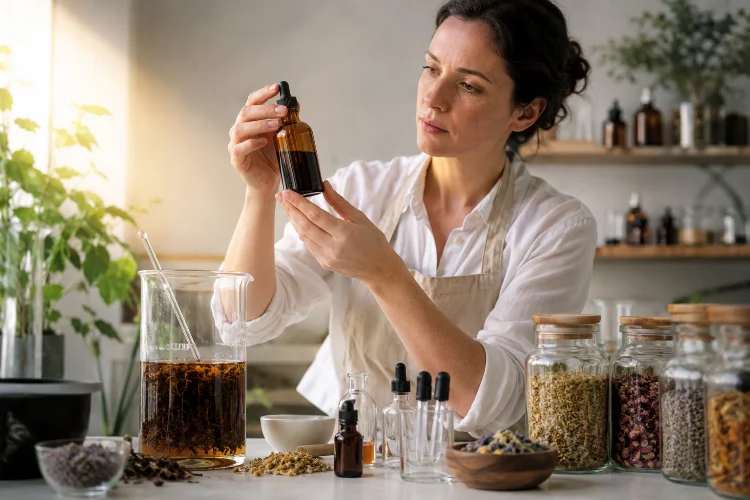
A small amber bottle filled with dark herbal liquid can look mysterious if you are new to herbalism. The label may mention a plant name, an alcohol percentage, and a ratio such as 1:5-but what do those details actually mean?
That bottle may contain an herbal tincture, a liquid preparation produced by extracting constituents from plant material with alcohol or a mixture of alcohol and water.
The World Health Organization describes tinctures as alcoholic or hydroalcoholic extracts, commonly produced using processes such as maceration or percolation.
Understanding what herbal tinctures are and how extraction works is useful because tinctures are fundamentally different from simply swallowing powdered herbs or making a quick cup of tea.
The solvent, plant-to-liquid ratio, extraction method, plant part, and chemical properties of the herb all influence what ends up in the finished liquid.
And while tinctures can be convenient, concentrated does not automatically mean safer or more effective.
What Exactly Is an Herbal Tincture?
A tincture is a type of liquid herbal extract.
WHO describes tinctures as preparations generally made using alcohol or a combination of alcohol and water.
A common traditional manufacturing range uses approximately one part herbal material to five to ten parts solvent, although the actual formulation varies according to the specific product and pharmacopoeial standard.
The plant material might include leaves, flowers, roots, bark, or another correctly identified botanical part.
During extraction, selected chemical constituents move from the plant tissue into the surrounding liquid. The solid plant material is eventually removed, leaving the liquid extract behind.
This makes tinctures fundamentally different from powdered herbs, where the actual ground plant remains in the finished product.
It also distinguishes them from herbal infusions, which primarily use water for a relatively short extraction period.
How Does Herbal Extraction Actually Work?
Extraction sounds complicated, but the basic idea is easy to visualize.
Imagine dropping sugar into water. Molecules leave the solid material and dissolve into the liquid. Herbal extraction follows a more complicated version of the same principle.
Plant tissues contain many chemical constituents with different physical properties. Once herbal material comes into contact with an appropriate solvent, compounds that are soluble in that solvent can gradually move out of the plant tissue and into the liquid.
WHO describes maceration as a process in which constituents are extracted through dissolution into the solvent.
Several factors influence this process, including particle size, solvent choice, herb-to-solvent ratio, temperature, extraction time, and the method being used.
This is why making an extract is not simply a matter of putting “some herbs” into “some alcohol.”
The details affect the resulting chemical profile.
Why Do Tinctures Often Use Alcohol and Water Together?
Water is an excellent solvent for certain plant compounds, but it does not dissolve everything equally well.
Alcohol behaves differently.
WHO explains that plant constituents have different polarities and move into solvents according to their chemical properties-the familiar chemistry principle sometimes summarized as “like dissolves like.”
More polar compounds tend to prefer more polar solvents, while less-polar substances may require a diffrent solvent environment.
This helps explain why many tinctures use a mixture of ethanol and water rather than either liquid alone.
Changing the alcohol percentage changes the extraction environment.
A preparation containing 40 percent ethanol may therefore extract a somewhat different range or proportion of constituents than one made with 70 percent ethanol.
EMA herbal monographs demonstrate this variation in practice: peppermint-leaf tinctures, for example, have been documented with a 1:5 ratio using 45 percent ethanol, while other herbal tinctures use different ethanol concentrations.
That does not mean higher alcohol is always better.
The appropriate solvent depends on the plant and the constituents the preparation is intended to contain.
What Is Maceration?
Maceration is probably the easiest extraction method for beginners to understand.
The plant material is reduced to an appropriate size, mixed with solvent, and allowed to remain in contact with that solvent for a defined period.
The mixture may be agitated periodically before the liquid is eventually separated from the remaining solid plant material.
WHO notes that after maceration, the herbal material may be strained or pressed and the liquid clarified through processes such as filtration.
Time matters because extraction does not happen instantly.
However, longer is not automatically better. Temperature, plant particle size, solvent concentration, and chemical stability can all affect extraction efficiency.
WHO specifically notes that inappropriate processing conditions may damage heat-sensitive compounds or create unwanted changes.
So while traditional homemade tinctures may appear simple, standardized manufacturing tries to control these variables carefully.
What Is Percolation?
Percolation approaches extraction differently.
Instead of leaving the herb sitting in one batch of solvent, the plant material is placed inside a vessel called a percolator. Solvent moves through the herbal material and exits through the bottom, carrying dissolved constituents with it.
WHO describes the material as typically being moistened first and then packed into the percolator before additional solvent is allowed to flow through it at a controlled rate.
This method is widely used in professional herbal extraction because flow rate, solvent quantity, and collection can be controlled.
Both maceration and percolation can produce tinctures, and WHO specifically lists both as standard methods for tincture preperation.
For a beginner, the important takeaway is not memorizing industrial equipment.
It is understanding that the word tincture describes the finished type of preparation, while maceration and percolation describe ways of getting there.
What Does a Ratio Like 1:5 Mean?
One of the most confusing things on a tincture label is the ratio.
You may see something like 1:5, 1:8, or 1:10.
These numbers describe the relationship between herbal material and the extraction solvent or extract, depending on the labeling system being used.
WHO’s general description of tinctures gives a typical range of approximately one part herbal material to five to ten parts solvent.
EMA documents show why the ratio cannot be assumed from the word “tincture” alone.
A valerian-root tincture has, for example, been described at a ratio of 1:8, while peppermint preparations have been documented at 1:5.
These ratios help describe how the extract was manufactured.
They do not, by themselves, tell you how clinically powerful the product is.
Two herbs prepared at the same ratio may contain completely different chemical constituents, and two tinctures of the same herb may differ because of solvent strength, raw-material quality, extraction procedure, or plant part.
How Are Tinctures Different From Herbal Tea?
Tea and tinctures both extract plant constituents into a liquid, but their extraction conditions are very different.
WHO describes an infusion as a relatively dilute preparation made by steeping herbal material in boiling water, often for roughly 5-20 minutes.
A tincture typically involves alcohol or hydroalcoholic solvent and a much longer or more controlled extraction process.
That means the resulting chemical profiles may not be identical.
A cup of peppermint infusion should therefore not automatically be considered chemically equivalent to peppermint tincture simply because both started with peppermint leaves.
The same principle applies to decoctions, oils, glycerites, powders, and dried extracts.
The preparation method is part of the product.
When reading herbal research, always check whether researchers studied a tincture, tea, powder, standardized extract, or another formulation before assuming the findings apply to something else.
Are Tinctures More Concentrated Than Tea?
Tinctures are often described as concentrated herbal preparations, but the word “concentrated” can be misleading if it is treated as a synonym for “stronger medicine.”
Tinctures typically use defined ratios between plant material and solvent, whereas everyday herbal infusions are often more dilute.
However, concentration alone cannot predict effectiveness.
The biological importance of an extract depends on which compounds are present, their amounts, the dose consumed, how well they are absorbed, and whether credible clinical evidence supports the intended use.
Modern herbal medicine also includes many product types beyond tinctures, such as tablets, capsules, powders, teas, and other extracts.
So the right question is not:
“Is tincture stronger?”
A more useful question is:
“What preparation was studied, what does it contain, and what evidence supports its use?”
That distinction prevents a lot of misunderstandings in beginner herbal education.
Does Alcohol Extract Every Useful Plant Compound?
No single solvent extracts everything equally.
WHO’s processing guidance explains that compounds with different chemical polarities distribute into different solvents. More polar constituents may favor water or alcohol-water mixtures, while less-polar constituents may behave differently.
This is why herbal science includes many forms of extracts rather than one universal extraction liquid.
It also means an alcohol-based tincture is not automatically a “complete” representation of everything present in a plant.
Some compounds may be extracted efficiently, others only partially, and some very poorly.
Processing can matter as well. Grinding herbal material increases surface area and may improve transfer into the solvent, but WHO warns that excessive grinding can also expose material to mechanical heating and oxidation.
Extraction is therefore a compromise between chemistry, plant structure, product quality, and practical manufacturing.
This is why standardized extracts try to document the variables rather than simply calling the result “herbal liquid.”
Tinctures and Herbal Safety
The fact that a substance came from a plant does not make its extract automatically harmless.
MedlinePlus notes that herbal medicines can cause serious adverse effects and can interact with prescription or over-the-counter medicines. NCCIH also highlights herb-drug interactions, direct toxicity, and contamination as important safety concerns surrounding herbal products.
Tinctures add another consideration because many contain alcohol.
This may matter for children, pregnancy, certain medical conditions, people avoiding alcohol, or situations involving medications where alcohol exposure is relevant.
The specific herb also matters far more than the format alone.
St. John’s wort, for example, is known for clinically important interactions with numerous medicines, illustrating why an herbal extract should never be treated as harmless simply because it is sold without a prescription.
For anyone taking regular medication, preparing for surgery, pregnant or breastfeeding, or managing a medical condition, discussing herbal products with a qualified healthcare professional is sensible.
How Beginners Should Read a Tincture Label
Instead of judging a tincture by attractive packaging, look at the technical information.
Start with the botanical name and plant part. “Echinacea tincture” is less informative than a label identifying the exact species and whether the preparation uses root or aerial parts.
Then check the ratio and extraction solvent.
A properly described product may tell you the relationship between herbal material and solvent along with the ethanol percentage. EMA documents show that these details are routinely used to distinguish specific herbal preparations.
Also look for dosage instructions, warnings, manufacturer details, and quality information.
Do not assume two bottles are equivalent simply because the same herb name appears on the front.
The ratios, solvent concentrations, preparation methods, and starting materials may all be seperately different.
The label is not just marketing-it can tell you what kind of extract you are actually buying.
Herbal tinctures are liquid extracts typically produced with alcohol or a mixture of alcohol and water.
Instead of briefly steeping plants like an herbal tea, tincture production uses controlled extraction methods such as maceration or percolation to move selected plant constituents into a solvent.
The herb-to-solvent ratio, ethanol percentage, extraction time, plant part, and chemical properties of the herb can all influence the finished preparation.
Most importantly, tinctures are not automatically superior to teas, powders, or other extracts. They are simply a diffrent way of preparing plants.
If you are beginning to study tinctures, start by reading labels closely. Compare the botanical name, plant part, ratio, and extraction solvent, then look up the evidence and safety information for that specific preparation.
Understanding those details is far more valuable than simply choosing the bottle that claims to be the strongest.