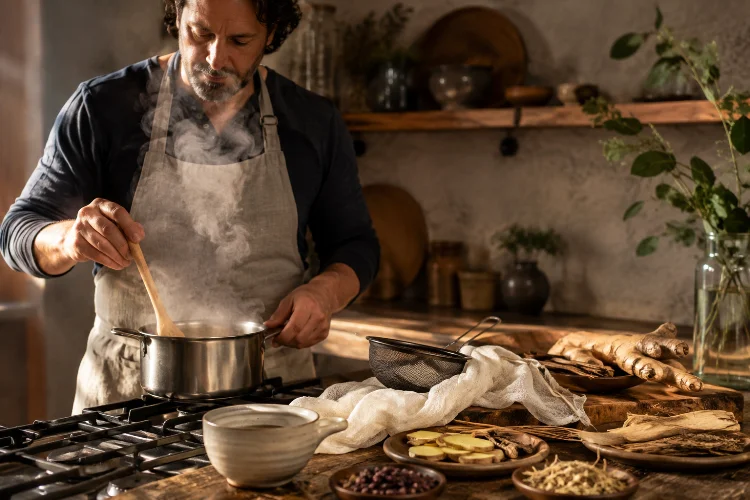
If you have ever simmered ginger, roots, bark, or spices in a saucepan instead of simply pouring hot water over them, you have already encountered the basic idea behind a herbal decoction.
Decoctions are one of the oldest and simplest ways of preparing plant material with water. Unlike a quick cup of herbal tea, the herbs are generally heated or boiled with water for a period of time before the liquid is strained.
The World Health Organization defines a decoction as a water-based herbal preparation made by boiling herbal materials with water.
They are particularly familiar in many traditional herbal systems, but that does not mean every root, bark, or medicinal plant should automatically be boiled.
Understanding what herbal decoctions are and when they are commonly used requires looking at the plant part, preparation instructions, concentration, and safety of the specific herb.
For beginners, the most useful lesson is simple: decoction is a preparation method, not a guarantee that the resulting drink is safe or medically effective.
What Is an Herbal Decoction?
An herbal decoction is made by heating plant material in water so that water-soluble components move from the plant into the liquid.
WHO describes decoction specifically as a preparation involving herbal materials boiled with water, while European Medicines Agency guidance recognizes decoction alongside infusion and maceration as methods for preparing aqueous herbal products.
After heating, the solid plant material is normally strained away and the remaining liquid is used according to the appropriate preparation instructions.
This sounds similar to making tea, and in a broad sense it is. The biggest practical difference is usually the way heat is applied.
With an infusion, boiling or hot water is generally poured over plant material and left to steep. With a decoction, the plant material is heated in the water, often for longer.
That extra heating is why decoctions are frequently associated with tougher herbal materials.
Why Are Roots and Bark Often Used in Decoctions?
Leaves and flowers are generally soft and thin. Hot water can penetrate them fairly easily, which is one reason they are commonly prepared as infusions.
Roots, rhizomes, seeds, and bark can be much denser.
Traditional preparation methods may therefore use simmering or boiling to extract substances from these tougher materials.
EMA documentation provides real examples: dandelion root has been described in an assessment report as a decoction prepared by slowly heating cut root in water to boiling, leaving it for 10 minutes, and then straining it.
Turmeric rhizome is another example for which EMA documentation includes infusion, decoction, or maceration among traditional aqueous preparations.
However, avoid turning this into the rule that all roots equal decoctions.
Some roots can be prepared in several ways, and certain constituents may respond differently to heat or extraction conditions. The correct preperation depends on the actual species, plant part, and intended use.
Herbal Decoction vs Herbal Infusion
The easiest way to understand decoctions is to compare them with infusions.
Imagine making peppermint tea. You might place peppermint leaves into a cup, pour hot water over them, cover the cup, allow the leaves to steep, and then strain them.
That is an infusion.
Now imagine putting cut dandelion root into a saucepan with water, slowly bringing it to a boil, keeping it heated according to the relevant instructions, and then straining it.
That is a decoction.
EMA’s herbal standards treat infusion and decoction as distinct aqueous preparation techniques, but the boundary is not always based simply on whether the ingredient is a leaf or root.
Willow bark illustrates this nicely. EMA documentation includes both an infusion and a decoction among preparations involving willow bark.
So rather than memorizing “leaves are infused, roots are boiled,” learn the recommended preparation for each herb individually.
How Is a Basic Decoction Traditionally Prepared?
There is no universal recipe that is correct for every medicinal plant.
However, the basic process usually involves combining an appropriate quantity of plant material with water, heating it, allowing extraction to occur for a specified period, and then straining the liquid.
A documented dandelion-root method, for example, begins with cold water, slowly heats the mixture to boiling, leaves it for about 10 minutes, and then strains it.
Other plants may use differnt amounts of herbal material, water volumes, or heating times.
That variation matters.
You may see online instructions telling people to “simmer every root for 20 minutes” or “boil medicinal herbs until half the water disappears.” Those rules are too broad to apply safely to every species.
For home learning, begin with herbs whose identity and preparation method are well established.
Measure the ingredients instead of throwing random handfuls into a saucepan, and follow a credible herbal monograph or professional guidance when the preparation is intended for therapeutic use.
Does Longer Boiling Make a Decoction Stronger?
Longer heating can change what is extracted into the water, but that does not mean that boiling an herb for as long as possible creates a better preparation.
Heat can affect plant compounds in different ways.
Some substances extract readily into hot water. Others are poorly water-soluble, while some constituents may change or degrade under prolonged heating.
The amount of water matters too. Allowing large amounts of water to evaporate produces a more concentrated liquid, which may change the dose of compounds someone consumes.
This is why standardized herbal guidance provides specific preparation instructions rather than simply recommending “extra strong” decoctions.
EMA monographs and assessment reports can specify quantities of herbal material, water volume, preparation method, and frequency for individual herbal products.
A useful beginner principle is therefore:
Follow the herb, not the method.
Do not assume that more plant material, hotter temperatures, or longer boiling automatically creates a more beneficial drink.
When Are Decoctions Commonly Used?
Decoctions have a long history within traditional medicine systems around the world. WHO materials recognize them as common forms of water-based herbal preparation in traditional medicine contexts.
They are often encountered when preparing relatively dense plant materials and in traditional formulas containing several ingredients.
The exact use varies enormously by culture.
Traditional Chinese herbal medicine, for example, has a long history of preparing multi-herb formulas as decoctions. WHO material describing Chinese medicine services even references traditional Chinese herbal decoctions prepared for patients.
Other traditions may use decoctions quite differently.
This cultural diversity is important because “decoction” only tells you how the plant is being extracted with water. It does not tell you what medical system the formula belongs to, why it was selected, or whether modern clinical research supports the traditional indication.
Those are separate questions.
Decoctions Are Not Always Taken as Drinks
Another common misunderstanding is that every decoction is designed for drinking.
Some are not.
EMA’s monograph on oak bark, for instance, describes decoction preparations for oromucosal or cutaneous use rather than simply treating decoction as an oral beverage.
Horsetail has also been documented in an EMA assessment report as a decoction preparation for cutaneous use.
This provides an important reminder for beginners.
Finding instructions that say “prepare a decoction” does not automatically mean you should swallow it.
Always check the intended route of use.
A preparation designed for washing, rinsing, bathing, or topical application may have completely different concentrations and safety considerations from something intended for oral consumption.
Are Herbal Decoctions Safe?
Safety depends on the herb, dose, concentration, individual, and intended use-not simply on the fact that the preparation contains plants and water.
MedlinePlus advises that herbal medicines can have biological effects, side effects, and interactions with other medicines. NCCIH similarly warns that some herbal products can interact harmfully with medications.
Concentrated preparations deserve particular respect because increasing the amount of plant material can increase exposure to its constituents.
Certain herbs may also be inappropriate during pregnancy or breastfeeding, for children, before surgery, or for people taking prescription medicines.
Correct botanical identification matters as well. Never prepare a decoction from a wild root or bark merely because it resembles something pictured online.
If an herbal preparation is being considered for a medical problem, especially alongside medication, discuss it with an appropriately qualified healthcare professional.
Natural does not mean harmless.
Common Mistakes Beginners Should Avoid
One common mistake is using the same decoction recipe for every hard plant part.
Another is confusing culinary familiarity with unlimited safety. Ginger or turmeric may be familiar foods, but concentrated herbal preparations are not necessarily equivalent to normal amounts used in cooking.
Beginners may also boil delicate aromatic herbs unnecessarily. Leaves and flowers containing volatile aromatic compounds are often prepared differently from dense roots or bark, depending on the species.
Finally, avoid making health claims based simply on the preparation method.
A decoction is an extraction technique. Boiling an herb for 20 minutes does not transform weak scientific evidence into strong evidence.
Traditional use, laboratory research, clinical effectiveness, dosage, and safety should all be considered seperately.
That distinction is one of the foundations of responsible modern herbal education.
How Beginners Can Learn Decoctions Safely
Start by learning one plant at a time.
First identify its correct botanical species and the plant part being used. Then determine whether authoritative references describe it as an infusion, decoction, maceration, extract, or another preparation.
Study the actual method instead of improvising.
Notice how much plant material is used, how much water is added, whether the mixture starts with cold or boiling water, how long it is heated, and whether the finished preparation is intended for drinking or external use.
EMA herbal monographs and assessment reports are particularly useful learning tools because they demonstrate just how much preparation instructions can differ between herbs.
And remeber: learning how a traditional preparation is made is not the same as receiving medical advice to use it.
Understanding that difference allows you to explore herbalism with curiosity without losing sight of evidence and safety.
Herbal decoctions are water-based preparations made by heating or boiling plant material in water.
They are commonly associated with tougher materials such as roots, rhizomes, seeds, and bark, although plant part alone does not determine the correct preparation method.
Unlike a simple infusion, a decoction generally exposes the herbal material to sustained heating. The exact amount, temperature, duration, concentration, and intended use can vary significantly between plants.
If you are learning herbal preparation, resist universal recipes. Choose one well-identified herb, consult a reliable monograph, and study why that particular preparation is recommended.
The goal is not to make the strongest possible herbal drink. It is to understand the plant, the extraction method, and the evidence behind using it responsibly.