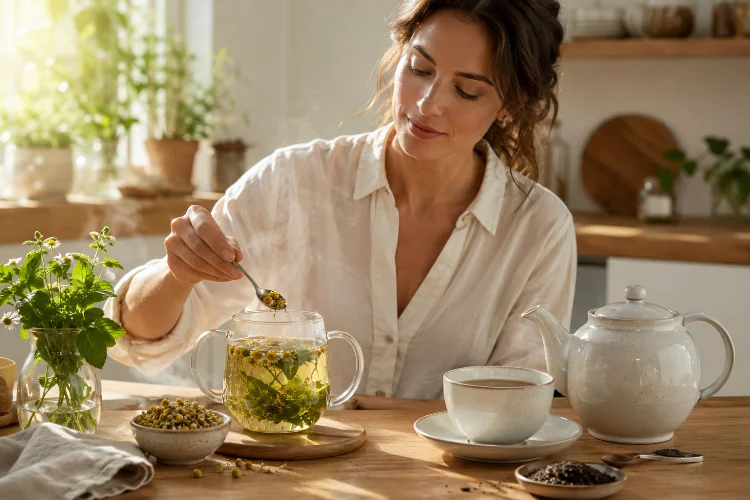
At first glance, an herbal infusion looks exactly like an ordinary cup of tea. You place plant material in a cup, add hot water, wait for a while, and drink the result. So why do herbalists sometimes call one drink an “infusion” instead of simply calling it tea?
The difference is partly about terminology and partly about preparation.
Traditional tea usually refers to drinks made from Camellia sinensis, the plant used to produce green, black, white, and oolong teas.
Herbal beverages, meanwhile, may be prepared from completely different plants such as chamomile flowers, peppermint leaves, ginger, or lavender. FDA materials identify Camellia sinensis as the source of conventional tea.
An herbal infusion is more specifically a water-based preparation created by steeping herbal material. Depending on the herb and purpose, it may use different quantities and steeping times from an everyday beverage.
Understanding that distinction helps beginners prepare herbs more thoughtfully instead of assuming every cup follows the same formula.
What Exactly Is an Herbal Infusion?
An infusion is essentially a method of extracting water-soluble substances from plant material using water.
European Medicines Agency documents describe herbal teas as aqueous preparations made from one or more herbal substances and identify infusion as one of the standard preparation methods used for them.
Leaves and flowers are especially common candidates for infusion because hot water can penetrate their relatively soft tissues easily.
Chamomile flowers, peppermint leaves, lavender flowers, lemon balm, and many other herbs can be prepared this way. Herbal medicines themselves are available in many forms, including teas, extracts, powders, capsules, and fresh or dried plant material.
In everyday conversation, people often call almost every hot herbal beverage “tea.” That is perfectly normal.
In herbal education, however, the word infusion draws attention to the extraction method rather than simply the finished drink.
Herbal Tea Is Not the Same as True Tea
One of the easiest distinctions to understand is botanical.
Green tea, black tea, white tea, and oolong tea all come from Camellia sinensis. Their differences largely result from how the leaves are harvested and processed.
FDA documentation describes tea from Camellia sinensis as containing a complex mixture of compounds, including polyphenols.
Chamomile “tea” does not contain Camellia sinensis unless it has been blended with conventional tea leaves.
Neither does pure peppermint, ginger, hibiscus, or lavender tea.
These drinks are therefore often called herbal teas or tisanes. Technically, many of them are also infusions because hot water is being used to extract substances from the plant.
The confusing part is that “tea” can describe both a specific botanical beverage and, casually, almost any plant steeped in hot water.
Context matters more than getting overly strict about terminology.
Steeping Time Can Be Very Different
An everyday cup of green or black tea is usually brewed relatively quickly.
American Camellia Society guidance, for example, suggests roughly two to three minutes for green tea and around three to five minutes for black tea, depending on the desired style.
Herbal preparations can vary much more.
EMA monographs show that some herbal infusions are prepared for five to ten minutes, while the recommended amount of plant material also changes according to the particular herb and intended preparation.
That means there is no universal rule saying an herbal infusion must steep for exactly 10, 20, or 30 minutes.
A casual peppermint drink might be prepared fairly quickly because the goal is simply an enjoyable beverage. A preparation described in an official herbal monograph may specify a different amount of plant material, water volume, or steeping period.
The correct method depends on the specific herb and purpose.
Longer does not automatically mean better.
Herbal Infusions May Use Different Amounts of Plant Material
Another difference is concentration.
Everyday tea is usually prepared primarily for taste. You use enough leaves or a tea bag to make a pleasant drink, steep it briefly, and adjust the strength according to preference.
Some traditional or standardized herbal preparations are more specific.
For example, EMA herbal monographs may describe a particular number of grams of dried plant material in a specified volume of boiling water.
One monograph for lavender describes an infusion prepared from approximately 1–2 grams of plant material in 150 milliliters of water.
Another monograph may use a completely diffrent ratio because plant chemistry, traditional use, and the intended preparation differ.
This illustrates an important point.
There is no standard “herbal infusion strength” that applies to every plant.
Adding twice as much herb does not automatically create twice the benefit, and stronger preparations may also increase exposure to unwanted effects.
Infusions Work Best With Certain Plant Parts
When beginners first discover herbal preparations, they sometimes assume hot-water infusion is appropriate for everything.
It is especially convenient for softer plant parts such as leaves and flowers.
Tougher materials may require a different approach.
Roots, seeds, bark, and woody plant parts can sometimes be prepared as decoctions, which generally involve simmering the material rather than simply pouring hot water over it.
EMA materials distinguish infusion, decoction, and maceration as different methods of preparing herbal teas and related products.
That distinction exists because plant structure matters.
A delicate chamomile flower releases constituents into water differently from a dense piece of root or bark.
This does not mean every root must be boiled or every flower must only be infused. Individual herbal instructions still matter.
But as a beginner’s framework, think:
Soft leaves and flowers often suit infusions; tougher plant material may need another extraction method.
Everyday Herbal Tea Is Often About Enjoyment
Purpose is another important difference.
Many people drink peppermint, chamomile, ginger, or similar herbal beverages because they enjoy the flavour, warmth, aroma, and ritual.
There is nothing wrong with that.
Chamomile, for example, is commonly consumed in tea-sized food amounts, and NCCIH reports that oral use at quantities commonly found in tea and food is likely safe for most people.
An everyday herbal beverage does not need to become a complicated therapeutic experiment.
You might add mint leaves to hot water simply because it tastes refreshing. You might enjoy chamomile before bed without treating the drink as medication.
An herbal infusion used within formal herbal practice may involve more attention to the identity of the plant, quantity, frequency, intended purpose, and available safety information.
The physical process can look almost identical while the reasoning behind it is quite different.
A Stronger Infusion Is Not Automatically More Effective
This is one of the most important concepts for beginners.
It is tempting to think:
“If one teaspoon is good, four teaspoons must be better.”
Herbal preparations do not work that way.
Plants contain multiple chemical constituents, and increasing the amount of plant material may increase exposure to both desirable and undesirable substances.
Herbal products can cause side effects or interact with medications. MedlinePlus therefore advises treating herbal medicines with the same caution used for other health products.
Even familiar herbs are not universally appropriate.
Chamomile can cause allergic reactions in some people, particularly those sensitive to related plants, while herbal products can interact with medications depending on the species involved.
Concentration should therefore be based on reliable guidance rather than the assumption that stronger means healthier.
When learning herbalism, precision is more useful than intensity.
Caffeine Is Another Major Difference
Traditional tea from Camellia sinensis naturally contains caffeine, although the amount varies with the product and preparation.
Pure herbal infusions made from plants such as chamomile or peppermint are not made from the tea plant and therefore differ chemically from conventional tea.
However, never assume every product labelled “herbal tea” is automatically caffeine-free.
Blended products can contain green tea, black tea, mate, or other caffeinated ingredients. Always read the ingredient list.
This becomes especially relevant when someone chooses herbal beverages because they want to reduce caffeine intake.
The botanical identity of the ingredients tells you much more than the word “tea” on the front of the box.
How Water Temperature Changes the Experience
Water temperature also influences extraction and flavour.
Conventional green tea is often prepared with water below boiling temperature to avoid excessive bitterness, while black tea commonly tolerates hotter water.
Many herbal infusions are prepared using boiling or near-boiling water. EMA monographs frequently describe adding boiling water to dried herbal material when preparing traditional herbal teas.
But again, the exact method depends on the plant.
Delicate aromatic materials may produce a different flavour if exposed to very high temperatures or steeped excessively long.
A useful beginner habit is to record:
the herb, amount used, water volume, temperature, steeping time, and final taste.
After a few experiments, you’ll begin to understand how small changes affect your preperation.
Do Herbal Infusions Have Proven Health Benefits?
This depends entirely on the herb and the claim being made.
Herbal medicines include many different species, and the quality of scientific evidence varies widely.
Some plants have undergone substantial research, while evidence for others remains limited or uncertain. MedlinePlus emphasizes that herbal products can have therapeutic properties but can also cause side effects and interactions.
Chamomile provides a useful example.
It has a long history of traditional use and has been investigated for several purposes, but NCCIH notes that evidence is insufficient for firm conclusions about many of the conditions for which chamomile is promoted.
So an herbal infusion should not automatically be described as a treatment simply because it contains a traditional medicinal plant.
“Traditionally used for” and “clinically proven to treat” are very different statements.
Good herbal education keeps that distinction clear.
A Simple Way to Make a Beginner Herbal Infusion
For an everyday beverage, begin with a familiar culinary herb sold or grown specifically for consumption.
Place the appropriate amount of fresh or dried plant material into a cup or teapot. Add hot water and steep according to reliable instructions for that specific herb.
Strain the plant material before drinking.
Do not automatically apply one recipe to every herb. EMA examples demonstrate that recommended quantities and preparation times can vary considerably between individual herbal substances.
Also make certain you know exactly what plant you are using.
Botanical identification becomes especially important with home-grown or wild-collected plants. A beautifully fragrant infusion is not worth making from a plant you cannot confidently identify.
Start simple, keep portions reasonable, and remeber that an enjoyable cup does not need to be extremely concentrated.
Herbal infusions and everyday cups of tea may look similar, but the terms describe different things.
Traditional tea comes from Camellia sinensis, while herbal beverages can contain leaves, flowers, roots, fruits, or other parts of entirely different plants. An infusion specifically refers to extracting plant material with water.
The biggest differences often involve the herb used, amount of material, water temperature, steeping time, plant part, and purpose.
Most importantly, there is no universal recipe for a “strong medicinal infusion.” Every plant has its own characteristics and safety considerations.
Start with one familiar herb such as peppermint or chamomile, learn its correct preparation, and compare a short everyday steep with established guidance. Understanding the plant is much more useful than simply making the cup stronger.