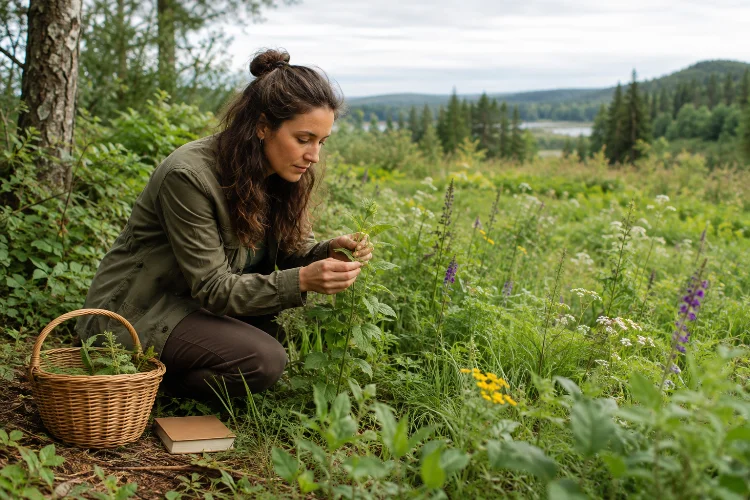
Walking through a meadow or woodland can feel completely different once you begin recognizing the plants around you.
What once looked like a wall of green suddenly becomes a collection of individual species, each with its own leaves, flowers, habitat, season, and ecological role.
That is part of what makes sustainable foraging for common wild herbs so fascinating.
Foraging can help you learn botany, understand local ecosystems, and develop a closer relationship with plants. But picking wild herbs responsibly requires much more than downloading an identification app and filling a basket.
Some edible plants have dangerous look-alikes. Wild populations can also be damaged by excessive collection, trampling, root harvesting, and careless disturbance.
On public land, collecting may be restricted or completely prohibited depending on the location. National Park Service rules, for example, vary among individual parks and plant species.
The best way to become a good forager is therefore to learn slowly. Identification comes first, harvesting comes later, and ecological responsibility should guide every decision.
Start by Learning Plants Before Harvesting Them
A beginner’s first foraging trip does not need to involve collecting anything.
In fact, some of your most useful outings can simply involve walking, observing plants, photographing them, and making notes about where they grow.
Choose a small number of common local species and study them repeatedly throughout the year. Notice leaf shape, leaf arrangement, stems, flowers, seeds, growth habit, smell, and habitat.
Seeing the same plant through several seasons builds much stronger identification skills than memorizing one photograph.
Wild violet offers a good example of why this matters. University of Minnesota Extension notes that its flowers can be distinctive, yet its leaves may resemble those of lesser celandine, a toxic plant.
A plant-identification app can help narrow possibilities, but it should not be your only source when deciding whether a wild plant is safe to handle or consume.
For edible or herbal use, identification needs to be certain-not “probably right.”
Learn the Dangerous Look-Alikes Too
One of the biggest mistakes new foragers make is studying only the plant they want.
If you want to identify a species safely, you should also learn what can be mistaken for it.
Members of the carrot family provide an important example. Poison hemlock can have finely divided leaves and clusters of small white flowers that may remind inexperienced observers of other members of the same family.
University of Minnesota Extension identifies poison hemlock as highly toxic and describes several potentially confusing related plants.
Queen Anne’s lace, also called wild carrot, illustrates the problem from the other direction: Minnesota Extension specifically warns that it can be confused with deadly poison hemlock.
This is why relying on one characteristic-such as flower colour, smell, or leaf shape-is risky.
Study several features together. Botanical keys, reputable field guides, university extension resources, herbarium records, and experienced local teachers are much better learning tools than a single social-media photograph.
When significant doubt remains, leave the plant alone.
Check Whether Foraging Is Actually Allowed
A plant growing in the wild is not automatically free to collect.
Rules can depend on land ownership, species, quantity, purpose, and conservation status. Private property requires the owner’s permission, while public land may have its own harvesting regulations.
For example, Shenandoah National Park generally protects plants from collection, although specific exceptions exist for certain fruits, berries, nuts, and mushrooms under defined conditions.
Other public lands may follow different systems and may allow limited personal collection or require permits.
Do not assume that rules from one forest or park apply somewhere else.
Before collecting, check the current regulations of the specific land manager responsible for that location. Pay attention to protected species, quantity limits, seasonal restrictions, and commercial-harvest rules.
Responsible foraging begins before you pick anything.
It is much easier to enjoy a walk when you already know what collection is permited and what should remain untouched.
Understand What Sustainable Harvesting Really Means
Sustainable foraging is not simply taking a small amount and assuming everything will be fine.
Different plants respond to harvesting in very different ways.
Picking several leaves from a vigorous perennial may have relatively little impact, while removing its root can kill the entire plant. Collecting flowers may reduce seed production, and stripping seeds repeatedly can interfere with future generations.
The USDA Forest Service has documented common stewardship principles among experienced gatherers that include minimizing disturbance, avoiding endangered species, and taking only what is needed.
Forest Service research also emphasizes that sustainable harvesting depends on the biology of the particular species and the long-term condition of its population.
This means there is no magical percentage that is sustainable for every herb.
Before harvesting, ask how the species reproduces. Is it abundant in this location? Are you taking leaves, flowers, seeds, stems, or roots? Will the plant survive what you remove?
For beginners, collecting renewable above-ground material from genuinely abundant species is generally a more sensible learning starting point than digging roots or bark.
Harvest From Abundant Populations, Not Rare Discoveries
Finding an unusual plant can feel exciting. That excitement is exactly when restraint matters most.
If you encounter only one or two specimens, photograph them and keep walking. A rare-looking plant is not something you need to add to your basket simply because you finally found it.
Instead, learn to recognize abundance.
A healthy population usually includes multiple individuals, different ages or sizes, and signs that the plants are reproducing successfully. Even then, avoid harvesting heavily from one small patch.
Spread your observations-and any permitted collection-across appropriate areas rather than repeatedly taking material from the exact same plants.
Also watch where you step.
Sustainable harvesting involves more than the target herb. Repeated trampling can damage neighboring vegetation, compact soil, disturb seedlings, or create informal paths through sensitive habitat.
The goal is for someone walking through after you to have little reason to know you were collecting there.
That mindset turns foraging from simple extraction into stewardship.
Choose Clean Locations for Edible Wild Herbs
Correct identification does not automatically make a plant appropriate to eat.
Where it grows matters too.
Roadside environments can contain pollutants associated with traffic and road materials. U.S. Forest Service research identifies hydrocarbons, salts, nitrates, heavy metals, pesticides, and dust among pollutants associated with roads and traffic.
Pesticide exposure is another consideration. EPA notes that pesticides can move beyond application areas through mechanisms such as spray drift and runoff.
Avoid collecting plants from areas where you cannot reasonably assess environmental conditions, especially places that may receive herbicide applications, industrial contamination, heavy traffic pollution, or other chemical exposure.
Urban parks are not necessarily unsafe, and remote locations are not automatically clean. The important habit is thinking about the site’s history and current management.
Check for signs indicating spraying or restricted access. Learn whether the land is actively managed and ask local authorities if you are uncertain.
And, of course, wash permitted edible plant material appropriately before use.
Take Only the Plant Part You Actually Need
Once you become confident with a species, harvesting technique matters.
If you only need leaves, there is usually no reason to pull out the entire plant. If you are collecting flowers, leaving plenty behind allows the plant to continue reproducing and provides resources for insects.
Root harvesting deserves particular caution because removing the root often kills the individual plant.
Bark collection can also seriously damage woody plants, especially when material is removed around a large portion of the stem.
Try to make clean cuts rather than tearing plants apart. Carry simple, clean scissors or pruners where collection is permitted, and avoid breaking neighboring vegetation while reaching for your target.
Do not collect more simply because the patch looks abundant.
Take what you realistically expect to process and use. Extra plant material that ends up forgotten and mouldering in a bag was not a sustainable harvest—it was simply unnecessary removal.
Learning restraint is one of the most useful skills a forager can develop.
Avoid Spreading Invasive Species While Foraging
Foragers move through exactly the kinds of places where seeds and plant material can attach themselves to boots, trousers, bags, tools, and vehicles.
That creates another responsibility: do not accidentally transport invasive organisms between habitats.
USDA APHIS recommends brushing dirt, seeds, and plant material from boots, clothing, and outdoor equipment before leaving an area. Cleaning footwear after hikes can further reduce the chance of moving unwanted organisms between sites.
This is easy to overlook because the seeds involved may be tiny.
Get into the habit of checking your socks, boot laces, trouser cuffs, backpack, and harvesting equipment after walking through vegetation.
If you recognize an invasive plant, do not casually move seeds or reproductive material somewhere else. Local rules may also govern removal and disposal.
A sustainable forager thinks beyond what goes into the basket.
What accidentally travels home on your boots can matter too.
Learn With an Experienced Local Forager
Books and websites are excellent resources, but they cannot fully replace learning with someone who knows the local landscape.
An experienced botanist, naturalist, herbal educator, Indigenous knowledge holder where appropriate and respectfully engaged, or skilled local forager can show you characteristics that photographs often miss.
You can learn what a plant looks like when young, where it naturally occurs, how it changes before flowering, what species commonly grow nearby, and which look-alikes appear in your region.
Guided walks are especially useful because identification becomes connected to habitat.
Instead of memorizing that a plant “has oval leaves,” you begin noticing relationships between soil, moisture, sunlight, elevation, neighboring species, and seasonal growth.
Local learning also helps with regulations and conservation concerns that a generic international field guide may never mention.
Take notes and photographs during these walks rather than trying to collect every plant you encounter.
Knowledge weighs nothing in your basket, and it is usually the most valuable thing you can bring home.
Keep a Foraging Journal
A simple journal can transform occasional plant walks into a real learning system.
Record the date, general habitat, weather, growth stage, flower characteristics, leaf arrangement, and any identification features you noticed.
Photograph the whole plant first.
Then take seperate images of the leaves, stem, flowers, fruit or seeds, and surrounding habitat. One close-up leaf photograph is rarely enough for reliable identification.
Return to the same locations during different seasons whenever appropriate. Seeing a familiar plant emerge, flower, set seed, and eventually die back gives you a much deeper understanding than seeing it once.
Keep uncertain plants labeled unidentified until you can verify them.
There is no prize for identifying everything immediately.
Good foragers are comfortable saying, “I don’t know this one yet.”
That small sentence can be one of the safest habits you develop.
Sustainable foraging is less about finding free herbs and more about learning how plants live within an ecosystem. Accurate identification, knowledge of dangerous look-alikes, legal awareness, clean collection sites, and careful harvesting all matter.
Start slowly. Learn a few common local species extremely well before thinking about filling a basket, and study their look-alikes just as carefully.
Harvest only where collection is allowed, avoid rare populations, minimize habitat disturbance, and take only what you can genuinely use.
Your next step can be simple: choose one common wild herb in your region and spend a season observing it without harvesting. Learn its leaves, flowers, habitat, and life cycle. By the time you eventually collect responsibly, you will understand far more than its name.