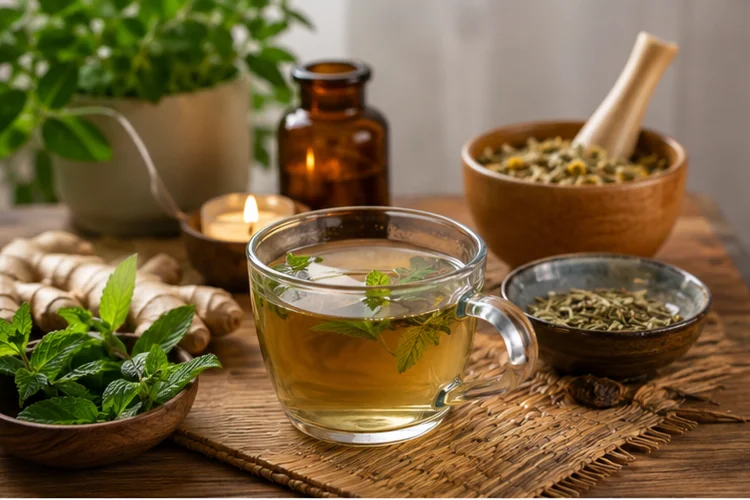
Almost everyone knows the feeling: you finish a large meal and suddenly feel unusually full, gassy, slightly nauseated, or simply uncomfortable.
Long before modern pharmacies existed, cultures around the world developed plant-based traditions for responding to these ordinary digestive complaints.
That history helps explain why peppermint, ginger, chamomile, fennel, caraway, and other aromatic plants still appear in teas, foods, and herbal preparations today.
European herbal monographs, for example, recognize long-standing traditional uses of fennel, chamomile, and caraway for certain mild digestive complaints such as bloating, flatulence, and minor spasms.
Understanding how herbal traditions approach everyday digestive comfort does not mean assuming every traditional remedy has been clinically proven. Traditional use, modern research, and personal experience are three different forms of information.
A sensible modern approach can respect historical plant knowledge while still asking important questions about evidence, preparation, dosage, safety, and when digestive symptoms deserve medical attention.
Digestive Comfort Means More Than Treating One Symptom
Traditional herbal practice often looks at digestion as a process rather than focusing on one isolated complaint.
A person might describe feeling overly full after eating, bloated, gassy, mildly nauseated, or uncomfortable in the upper abdomen. Modern medicine groups several of these experiences under terms such as indigestion or dyspepsia.
NIDDK notes that indigestion may include upper-abdominal discomfort, early fullness during meals, uncomfortable fullness after eating, bloating, nausea, and belching.
Traditional herbal systems historically developed their own terminology for these patterns.
Rather than thinking, “One herb equals one digestive disease,” herbs might be selected according to qualities such as bitterness, aroma, warmth, or the type of discomfort being experienced.
Food habits may also be considered.
Someone feeling uncomfortable after very heavy meals may be approached differently from someone experiencing occasional nausea or gas.
This broader perspective explains why many herbal traditions combine plants with changes in meal size, timing, preparation, and daily habits instead of relying exclusively on a single remedy.
Peppermint Is Closely Associated With Digestive Herbal Traditions
Peppermint is probably one of the most recognizable digestive herbs.
Its cooling aroma comes largely from volatile compounds such as menthol. Peppermint leaves are widely consumed as herbal tea, while concentrated peppermint oil is used in other preparations.
Modern research provides some evidence for enteric-coated peppermint oil capsules in irritable bowel syndrome.
NCCIH reports that these preparations may modestly reduce short-term IBS symptoms such as abdominal pain, bloating, and gas, although long-term effectiveness remains uncertain.
Notice the important detail: most of this research concerns particular peppermint oil preparations, not an ordinary cup of peppermint tea.
That distinction is essential.
An enjoyable peppermint infusion may have a long tradition as an after-meal beverage, but research performed on concentrated enteric-coated capsules cannot automatically be applied to tea.
Peppermint oil can also worsen heartburn in some situations, particularly when formulations are not enteric coated.
So even a very familiar digestive herb has context, preparation, and safety considerations.
Ginger Has a Long Association With Nausea
Ginger is another plant that appears in food traditions and herbal systems across many cultures.
Its rhizome can be eaten fresh, dried, powdered, infused, or incorporated into concentrated supplements.
Among its most researched uses is nausea.
NCCIH reports that ginger has been studied for several types of nausea and vomiting.
Evidence suggests ginger supplements may help with pregnancy-related nausea, while research for situations such as motion sickness, postoperative nausea, or chemotherapy-related nausea is less consistent.
Again, preparation matters.
Many clinical studies use measured ginger supplements rather than a few slices of ginger floating in hot water. A homemade ginger drink should therefore not automatically be described as equivalent to a studied supplement.
Ginger can also cause unwanted digestive effects in some people, including heartburn, abdominal discomfort, diarrhea, or gas.
This is a useful reminder that a herb traditionally associated with digestive comfort can occasionally produce digestive discomfort itself.
Individual response matters.
Fennel and Caraway Represent the Aromatic Tradition
Walk through an old herbal text or traditional kitchen and you will often find aromatic seeds and fruits associated with digestion.
Fennel and caraway are two classic examples.
The European Medicines Agency recognizes sweet fennel fruit as a traditional herbal medicinal product for mild spasmodic gastrointestinal complaints including bloating and flatulence.
This classification is based on long-standing traditional use rather than the same level of evidence required for a newly approved pharmaceutical medicine.
Caraway fruit has a similar traditional role. EMA states that caraway preparations can be used for digestive complaints such as bloating and flatulence on the basis of their established traditional use.
These plants are particulary interesting because the boundary between food and herbalism becomes blurry.
Fennel and caraway may appear as culinary spices, after-meal preparations, teas, or components of more formal herbal products.
That does not mean eating unlimited amounts will improve digestion.
Instead, they demonstrate how traditional knowledge often developed around familiar aromatic plants that were already part of everyday food culture.
Chamomile Shows Why Gentle Herbs Still Need Context
Chamomile tea is often presented as one of the gentlest herbal drinks available.
German chamomile, Matricaria recutita, has a long history of use in European herbal medicine. EMA recognizes traditional preparations of chamomile flower for minor gastrointestinal complaints including bloating and minor spasms.
One documented preparation involves chamomile flower infused in hot water for several minutes, showing how a simple tea-style preparation can also exist within formal herbal traditions.
However, “gentle” should not become another word for “risk-free.”
People allergic to plants in the Asteraceae family may need to be more careful with chamomile preparations. Botanical identity also matters because several different plants are casually called chamomile.
This is one reason herbal education encourages students to learn Latin botanical names rather than relying exclusively on common names.
A cup may look simple, but knowing exactly what plant is inside it remains important.
Bitter Herbs Take a Different Approach
Not every traditional digestive herb is aromatic.
Many traditions also use bitter-tasting plants.
Artichoke leaf, for example, has a long history in European herbal medicine. EMA documentation recognizes traditional use of artichoke leaf preparations for digestive complaints that can include sensations of fullness, bloating, and flatulence.
Gentian root is another strongly bitter herb traditionally associated with appetite and digestive complaints such as fullness and flatulence.
This introduces a different herbal idea.
Instead of choosing a pleasantly aromatic after-meal plant such as fennel, some traditions use bitterness itself as part of the sensory experience.
Beginners should not assume that all bitter herbs are interchangeable, however. Different plants contain very different chemical constituents and may have their own contraindications.
“Bitter” is a sensory category, not a guarantee of safety or effectiveness.
Herbal Traditions Often Pay Attention to the Meal Itself
An interesting feature of traditonal digestive care is that herbs are rarely the whole story.
Meal size, eating speed, rich foods, alcohol, caffeine, and personal food triggers can all influence digestive symptoms.
Modern NIDDK guidance similarly notes that different foods and drinks may worsen indigestion in different people and that dietary adjustments can sometimes be part of treatment.
That makes simple observation surprisingly valuable.
Someone might notice that discomfort repeatedly appears after very fatty meals, large late-night dinners, fizzy drinks, or particular foods.
Keeping a short food-and-symptom journal can reveal patterns that randomly trying five herbal supplements may completely miss.
Herbal traditions can therefore be most useful when they encourage awareness rather than turning every uncomfortable sensation into an excuse to take another product.
A small fennel tea after a meal and permanently ignoring a diet that consistently causes distress are very different approaches.
Traditional Use Is Not the Same as Clinical Proof
This distinction deserves special attention.
When EMA describes an herb as a traditional herbal medicinal product, that wording has a specific meaning.
It reflects sufficiently long-standing medicinal use under the traditional-use framework; it should not be read as a claim that large modern clinical trials have conclusively demonstrated effectiveness.
Modern studies can sometimes provide additional support.
Peppermint oil for IBS is one example where clinical research exists, although NCCIH characterizes the evidence as limited and focused mainly on short-term relief.
Ginger provides another example where evidence varies according to the type of nausea being studied.
A responsible herbal learner therefore asks three seperate questions:
What has this plant traditionally been used for? What does current research actually show? And does that research apply to the preparation I am considering?
Those questions prevent traditional knowledge from being either blindly accepted or unnecessarily dismissed.
Know When “Everyday Discomfort” Is No Longer Everyday
Occasional mild fullness or gas is very different from persistent or severe digestive symptoms.
NIDDK advises seeking medical attention for indigestion accompanied by problems such as frequent vomiting, blood in vomit, black stools, unexplained weight loss, difficulty swallowing, jaundice, severe constant abdominal pain, or symptoms that do not improve.
Sudden changes in persistent gas symptoms, particularly when accompanied by abdominal pain, constipation, diarrhea, or weight loss, also deserve medical evaluation.
Herbs should not be used to repeatedly cover up unexplained symptoms.
Digestive discomfort can have many causes, including conditions that need proper diagnosis and treatment.
This is especially important for people taking medications, living with chronic digestive disorders, pregnant or breastfeeding, or considering concentrated herbal extracts.
Remeber that “natural” describes where something came from. It does not tell you whether it is appropriate for your particular situation.
Herbal traditions have approached everyday digestive comfort through several different plant categories.
Aromatic herbs such as peppermint, fennel, and caraway have long been associated with bloating and gas, ginger is closely connected with nausea, chamomile appears in traditional preparations for minor digestive discomfort, and bitter plants such as artichoke and gentian represent another historical approach.
The most useful modern approach is neither blind belief nor automatic rejection. Learn what the tradition says, then compare it with current evidence, preparation details, and safety information.
Start by studying one familiar digestive herb and its actual research rather than building a cupboard full of remedies. Understanding why, how, and when a plant has been used is much more valuable than simply memorizing a list of “herbs for digestion.”